


The paperwork follows the primary care physicians’ home, and the data backs up what every practice already feels. AMA figures from 2024 show physicians spend more than 20 hours a week on documentation and administrative work, time that has nothing to do with sitting across from a patient. That load is exactly what a primary care virtual assistant is built to absorb. Pairing trained remote support with dependable virtual medical assistant services, smart healthcare staffing solutions, and clean medical billing services gives a clinic room to breathe and strengthens revenue cycle management without adding a desk. Read further how a virtual medical assistant helps doctors reclaim work-life balance by keeping admin tasks from bleeding past the last appointment.
This guide covers what these assistants do, the tasks they take on, how they shape patient experience and cash flow, and how to pick one that fits.
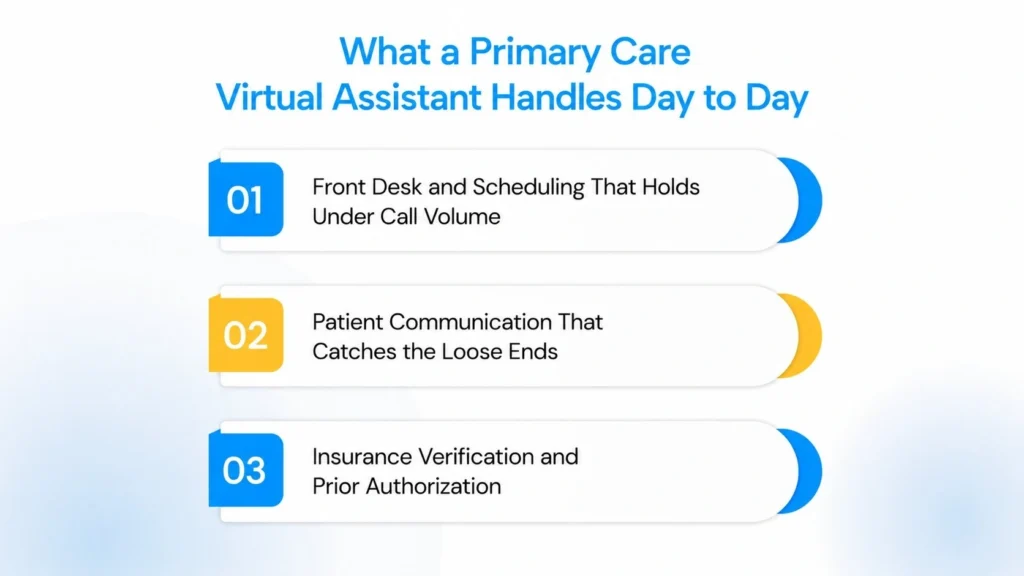
What a Primary Care Virtual Assistant Handles Day to Day
A primary care medical virtual assistant is a trained remote professional who takes on the recurring administrative and patient-facing work that keeps a clinic moving. The role reaches well past answering phones.
| Function Area | What the Assistant Covers |
| Front office | Scheduling, reminders, confirmations, waitlist management, missed-call follow-up |
| Patient communication | Inbound and outbound calls, secure messages, refill requests, referral coordination |
| Insurance and authorizations | Eligibility verification, benefit checks, prior authorization submission, and tracking |
| Documentation and records | EMR/EHR updates, chart prep, encounter notes, data entry |
| Revenue support | Charge entry, claim follow-up, and payment posting assistance |
Front Desk and Scheduling That Holds Under Call Volume
Primary care phones rarely go quiet. A virtual assistant for primary care clinics answers live, books correctly the first time, and clears the voicemail backlog that piles up whenever in-house staff gets pulled to the floor.
Every abandoned call is a quiet leak. The patient who can’t reach a person often drifts to urgent care for something the practice could have handled in five minutes.
Patient Communication That Catches the Loose Ends
Refill requests, lab result callbacks, referral status updates, and post-visit questions. These slip through the cracks fast in a busy clinic.
A virtual assistant works them inside your existing protocols and logs everything in the chart, so nothing depends on memory or a sticky note.
Patients notice when someone follows up, and that follow-through quietly drives retention more than any marketing line.
Insurance Verification and Prior Authorization
This is where the hours really stack up. The 2024 AMA Prior Authorization Physician Survey found practices complete an average of 39 prior authorizations per physician each week, consuming about 13 hours of physician and staff time.
A trained assistant runs eligibility verification before the visit and manages authorization submissions, so coverage surprises don’t blow up the schedule.
One caveat worth stating plainly: prior authorization rules and covered-benefit logic vary by payer, plan, and date of service, and they change often.
A good assistant confirms requirements against the payer’s current policy rather than assuming last quarter’s rules still hold.
How the Right Support Changes the Patient Experience
Patients judge a practice on access before anything clinical. When someone reaches a real person quickly and gets a timely reminder before the appointment, trust starts to build. Add a front desk that recognizes returning patients by name, and that trust turns into loyalty.
The reverse is just as real. A rushed scheduler juggling forty open tasks is the fastest way to make a loyal patient feel like a ticket number. Offloading the routine load lets your in-house team slow down on the interactions that matter, which shows up in reviews, referrals, and the no-show rate over time.
If you want a fuller breakdown of what changes once a practice hands off that load, we covered the top benefits of hiring a virtual assistant for doctors in a separate guide.
The Financial Case: Lighter Overhead, Steadier Cash Flow
The math favors remote support once you account for the full cost of an in-house hire. Salary is only part of the picture.
- A remote contractor carries no payroll taxes or employer benefits, and no paid leave to schedule around.
- There is no recruit-and-retrain cycle every time a front desk hire walks out the door.
- Cleaner claims and earlier eligibility checks cut the denials that stall payment.
- Coverage holds during staff shortages, without scrambling to backfill a vacant seat.
Denials are expensive, and the staff hours spent reworking them cost more than most managers ever track.
When a virtual medical assistant for family practice verifies coverage up front and follows claims through to payment, fewer dollars sit aging in accounts receivable.
That is the part of revenue cycle management providers feel directly, in the monthly collections report.
Choosing a Virtual Assistant for Primary Care Clinics
Not every remote support arrangement is built the same, and the difference shows within the first month. Look for these markers:
- Verified HIPAA compliance with documented data-security protocols
- Healthcare-specific training, not general call-center staffing
- Real familiarity with your EHR, whether that is Epic, Cerner, Tebra, or athenahealth
- Flexible terms without a long lock-in contract
- A named, consistent assistant instead of a rotating pool
A virtual medical assistant for family practice should slot into your workflow rather than force you to adapt to theirs. Worth noting: the clinics that get the most out of remote support are often the ones that write down their phone scripts and refill protocols before onboarding. That small habit pays off well beyond virtual staffing.
Frequently Asked Questions
What does a primary care virtual assistant do?
It handles the administrative and patient-facing tasks that crowd out clinical time: scheduling and reminders, inbound and outbound calls, refill and referral coordination, insurance eligibility checks, prior authorization, and EHR data entry. Most also support billing tasks like charge entry and claim follow-up.
How much does a primary care virtual assistant cost?
Pricing usually runs hourly or by service scope rather than as a fixed salary, so you pay for the support you use. Once you factor in benefits, payroll taxes, paid leave, and turnover, the all-in cost typically lands below an equivalent in-house seat. Ask for a clear rate structure before committing.
Are virtual medical assistants HIPAA compliant?
Reputable providers operate under full HIPAA compliance, with signed business associate agreements, access controls, and documented security protocols. Compliance is not automatic, though. Confirm it in writing and ask how patient data is accessed and stored before any assistant touches your systems.
Can a virtual assistant work inside our EHR?
Yes. Trained medical virtual assistants work directly in your existing EHR and practice management software, following your templates and workflows. Match the assistant’s experience to your specific platform during onboarding so there is no learning curve eating into the first weeks.
Is this only worth it for large clinics?
No, and small practices often see the sharpest gain. A solo or two-provider primary care office carries the same administrative load with far less staff to absorb it, so a single dedicated assistant frees up a disproportionate amount of provider time.
The Bottom Line
A primary care virtual assistant is less about cutting a line item and more about getting your team back to the work only they can do.
Phones answered, coverage verified, charts current, claims followed, all without the overhead and turnover that drain a practice.
The providers who feel it most are the ones drowning in the after-hours documentation and paperwork the AMA keeps documenting year over year.
If you want to see exactly where your hours and dollars are leaking before deciding anything, DoctorPapers will run a free practice analysis of your front-office and billing workflow and show you what a dedicated assistant could recover. No contract, no obligation, just a clear read on where the time is going.