


You’ve heard it before: hire a virtual assistant, reclaim your time, scale your practice. What you haven’t heard enough about is what actually happens when a virtual medical assistant sits down at their desk for the first time.
The job posting says “administrative support,” but the real medical virtual assistant duties span patient communication, data entry, scheduling, and increasingly, pre-billing tasks that touch your claims before they go out the door.
According to the Bureau of Labor Statistics, medical assistant roles (including virtual support roles) are projected to grow 16% between 2021 and 2031, outpacing most healthcare professions. Yet most practices still treat virtual medical assistant tasks as a generic bucket rather than a deliberate extension of their billing and operations workflow.
The difference between a virtual assistant who saves you money and one who costs you denials comes down to this: understanding exactly where they fit in your revenue cycle, what oversight they need, and which duties actually drive results versus which ones just look busy.
How Virtual Medical Assistants Fit Into Your Revenue Cycle
The first thing to understand is that what does a virtual medical assistant does depends entirely on where you position them in your operation. Some practices use them for patient-facing work only: scheduling, intake calls, and appointment reminders.
Others have them deep in pre-billing, pulling data, checking eligibility, and building charts. The best practices use them strategically for both, but with clear boundaries.
A virtual assistant working on revenue cycle tasks sits between your front desk and your billing team. They see patient contact details before the appointment, pull insurance eligibility information, verify coverage limits, flag potential prior authorization needs, and prepare clean chart notes that your coders don’t have to reconstruct from scattered emails and phone call summaries.
When this hand-off works, your billing team spends less time digging for information and more time coding and appealing. When it breaks down, claims go out with missing data, eligibility is wrong at submission, and denials pile up weeks later.
The critical insight most practices miss is that virtual assistant work in the revenue cycle isn’t about volume of tasks, it’s about precision. One eligibility check done wrong creates a denied claim. One missing prior authorization flag means the entire visit is unpayable until you appeal. That’s why the best virtual assistants for billing work aren’t the fastest; they’re the most detail-oriented.
Core Medical Virtual Assistant Tasks That Impact Your Bottom Line
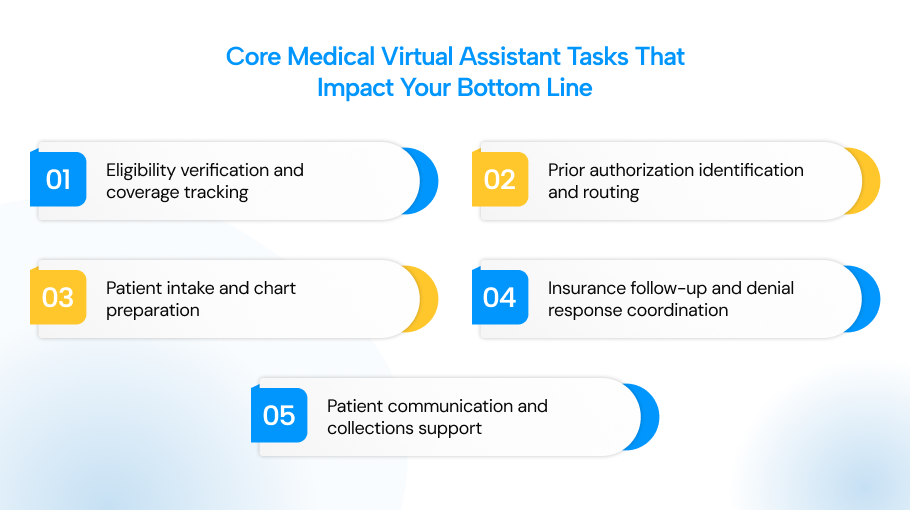
Here are the role of virtual medical assistant duties that directly influence whether claims get paid or denied:
- Eligibility verification and coverage tracking: Before the patient ever sits in your chair, your virtual assistant confirms active coverage, pulls deductible status, identifies out-of-pocket maximums, and checks plan-specific requirements. This single task, done thoroughly, prevents denials that stem from coverage gaps discovered after treatment.
- Prior authorization identification and routing: Your VA reviews the patient’s insurance plan documents, identifies procedures that require pre-authorization, submits requests to payers before the appointment when possible, and flags any that are pending so your clinician knows before they treat. Missed authorizations are approval waiting, not denials that require appeals.
- Patient intake and chart preparation: Instead of your clinical staff scrambling to piece together patient information from three different sources, your virtual assistant collects it systematically, organizes medical history, confirms emergency contacts, and prepares a clean chart template that your clinician and coder can work from immediately. Clean charts mean faster visits, fewer coding errors, and documentation that payers accept on first submission.
- Insurance follow-up and denial response coordination: Your VA monitors claim status, identifies denials as they arrive, organizes them by reason code, and prepares initial documentation packets for your appeals specialist or billing manager to review. They’re not resolving denials, but they’re removing the delay that comes from waiting for someone to notice a denial weeks after it lands in your system.
- Patient communication and collections support: Whether it’s pre-appointment reminders, post-visit follow-ups about balance due, or calling patients to confirm insurance information they provided incorrectly, your virtual assistant keeps patients engaged and informed. This work is administrative, but it’s not neutral: every patient who confirms their insurance before being treated is one fewer claim that gets submitted with wrong coverage information.
Where Virtual Medical Assistant Duties Create the Most Risk
Not all medical virtual assistant duties should be delegated the same way. Some tasks carry higher risk and require tighter oversight. Understanding the difference between low-risk and high-risk delegation separates practices that see real ROI from those that discover problems in their denial reports.
High-risk Tasks That Need Structured Oversight
Chart coding prep work. If your virtual assistant is labeling procedure codes or organizing documentation specifically for coding purposes, they need to understand coding logic enough not to introduce errors that your coder then has to catch and fix.
If your VA marks something as “Office visit, high complexity” when the documentation supports “routine visit,” your coder catches it, but now your coder is doing review work instead of coding. The math falls apart. Your VA needs either training on what makes a visit complex or permission to flag it for your coder to assign.
Insurance plan research and authorization determination. Your VA can pull plan documents and verify coverage. Your VA should not be deciding whether something needs prior authorization without clear decision rules. Plan rules vary.
A procedure that requires auth under Plan A doesn’t under Plan B. Your virtual assistant needs a simple checklist or template for each major payer, not judgment calls.
Lower-risk Tasks That Create Immediate Value with Minimal Oversight
Appointment scheduling and reminders. Schedule the appointment, send a reminder three days out, and call the day before to confirm. This is pure operational work with almost no downstream risk if it’s done consistently.
Patient contact information verification. Call patients, confirm their phone number, address, insurance member ID. Collect it cleanly. The margin for error is small, and it’s easy to verify.
Documenting patient communications. Your patient calls in about a billing question. Your VA documents what the patient said, the date, any action needed. This creates a paper trail that your billing team uses later. Consistency in documentation format matters more than complexity.
Building the Right Virtual Assistant Skill Set for Your Practice
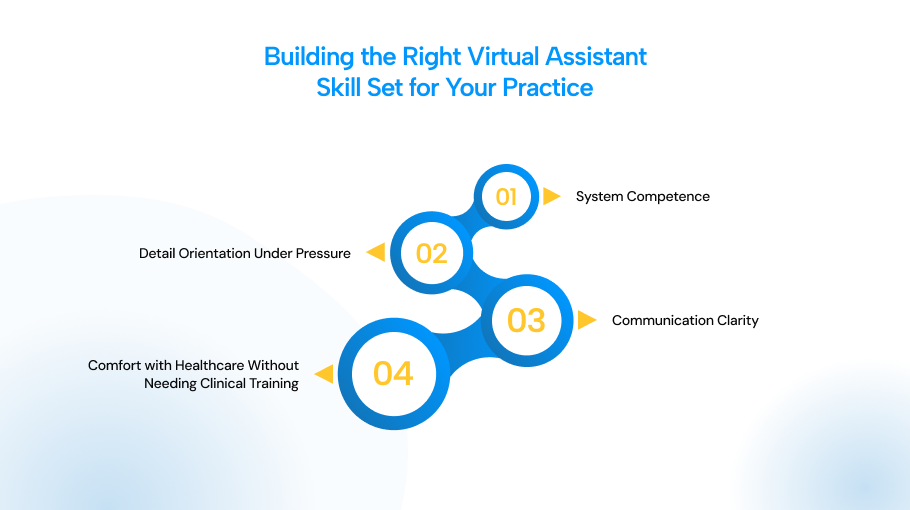
The title “virtual medical assistant” covers a huge range of capabilities. What you actually need depends on where you’re most constrained.
For billing-focused practices, the skill set that matters isn’t years of medical experience; it’s comfort with systems, accuracy with detailed work, and enough healthcare literacy to understand why precision in eligibility and prior authorization matters.
When you’re hiring or evaluating a virtual assistant for revenue cycle work, look for these signals:
1. System Competence
Can they learn your practice management software, your patient portal, your eligibility verification tools without extensive hand-holding. Do they take detailed notes on how to do tasks so they remember the next time. This matters more than prior medical experience.
2. Detail Orientation Under Pressure
Give them a test scenario: here’s a patient with three active insurance plans, one has changed since the last visit, and one has a prior auth that expires in two weeks.
Show them how to verify all three, flag the one that changed, and identify the one needing renewal. Watch how they approach it. Do they work systematically, or do they jump around?
3. Communication Clarity
When they don’t understand something, do they ask specific questions or do they nod and guess. Practices with low virtual assistant errors tend to have VAs who ask, confirm, and document what they’ve learned. That willingness to clarify is more important than having all the answers upfront.
4. Comfort with Healthcare Without Needing Clinical Training
They don’t need to know what CPT code 90834 means, but they do need to understand why submitting a claim with the wrong insurance information is worse than submitting it late. The reasoning matters because it drives how carefully they work.
What Different Virtual Medical Assistant Roles Actually Cover
| VA Role Type | Primary Focus | Revenue Cycle Impact | Oversight Level |
| Administrative only | Scheduling, reminders, patient contact info | Low to medium: removes scheduling bottlenecks, improves no-show rate | Light; mostly procedural tasks |
| Pre-billing support | Eligibility, prior auth, chart prep, data entry | Medium to high: prevents denials, reduces coder rework, speeds claim submission | Moderate; requires spot-check review of eligibility and auth determinations |
| Patient-facing plus pre-billing | Everything above plus patient communication, collections support | High: combines scheduling efficiency with claim quality | Moderate to high; needs training on healthcare terminology and clear decision rules |
| Specialized coding support | Organizing documentation, flagging ambiguous notes for coder review, and audit prep | Medium: reduces coder time on data gathering, doesn’t replace coding work | High; requires understanding of coding logic and documentation standards |
In the End
Your virtual assistant isn’t an answer to being understaffed. They’re a way to reallocate your existing staff from administrative busywork to work that requires judgment and experience.
When you bring a virtual medical assistant into your practice, you’re asking them to handle the threshold tasks that are predictable, repeatable, and detail-sensitive. That means less time your billing team spends hunting for eligibility information and more time they spend on appeals and complex claim issues where your practice actually makes money.
The practices that see real ROI from virtual assistants are the ones that use them deliberately. They don’t just add more hands. They shift the work so the hands they already have can focus on the things that only they can do.
That kind of delegation rarely works without structure, which is why many practices turn to partners like DoctorPapers to align virtual support with billing, documentation, and day-to-day operations. If you’re willing to invest in getting that structure right, a virtual medical assistant can change how your practice scales.
Frequently Asked Questions
Q: Can a virtual assistant actually reduce denials, or is that overstating it?
A:Directly, No. Your virtual assistant doesn’t prevent denials single-handedly. Indirectly, absolutely. When your VA confirms eligibility before treatment and flags expired authorizations, they’re removing the most common denial triggers: wrong insurance information and unbilled services.
They’re also organizing charts so your coder has clean documentation on first read, which means fewer coding errors that payers interpret as billing fraud.
Q: What’s the difference between a virtual assistant and a billing service?
A: Your virtual assistant works for you, learns your practice, knows your patients, and your payer relationships over time. A billing service is a vendor relationship where you send them patient data and get claims back.
Virtual assistants are better for workflow integration and understanding nuance. Billing services are better if you’re completely understaffed and need someone to own the whole revenue cycle. Most medium-sized practices use both at different points in the workflow.
Q: How much training does a virtual assistant need before they’re useful?
A: You should expect four to six weeks of active training on your systems and workflows before a virtual assistant is working independently on anything that touches claims. That’s orientation to your PM software, your payers, your clinical teams, your specific decision rules.
It sounds like a long runway, but the payoff is an assistant who doesn’t need hand-holding every day. The practices that complain about virtual assistants not working out usually cut corners on training.
Q: Should a virtual assistant ever have access to patient financial information or credit cards?
A: Your VA will see insurance information and financial responsibility documents as part of routine work. That’s unavoidable and okay. Storing or processing credit card data through their system is a different question and depends on your compliance structure and their access controls.
Talk to your compliance officer about what’s safe. Most practices use external payment processors specifically so virtual assistants never touch actual card data.
Q: Can you manage a virtual assistant if you’ve never hired remote staff before?
A: Yes, with one condition: be explicit about expectations and feedback. Remote staff can’t read the room the way in-office staff can. You need to be specific about deliverables, turnaround times, and the kind of communication you expect when they run into problems.
Weekly check-ins work better than daily ones. Written feedback and recorded training videos work better than verbal instructions given once. If you’re detail-oriented about those things, remote management isn’t harder than in-office supervision.