


Most practices don’t lose patients over a bad diagnosis or a rude interaction. They lose them slowly, through unanswered calls, missed reminders, and follow-ups that never happen. That slow leak is where medical virtual assistant patient retention work actually earns its keep, and it’s rarely where practices think to look first. A lot of clinics chase retention through better bedside manners or nicer waiting rooms, while the real damage happens in the gaps between visits. This is also where medical billing services, virtual medical assistant services, healthcare staffing solutions, and broader revenue cycle management start to overlap, because a patient who stops showing up eventually becomes a claim that never gets filed.
According to MGMA’s 2025 patient access research, practice leaders who maintained or improved no-show rates most often credited consistent patient communication, including frequent digital reminders, automated calls, and occasional live outreach, as the key factor.
That’s not a small detail. It means the practices holding onto patients aren’t doing anything dramatic. They’re just staying in touch better than everyone else.
Why Patient Retention Starts with How a Practice Communicates
A missed appointment rarely announces itself as a retention problem. It looks like scheduling friction, a slow callback, or a reminder that never went out. But add enough of those moments together, and a patient quietly moves to a practice down the street.
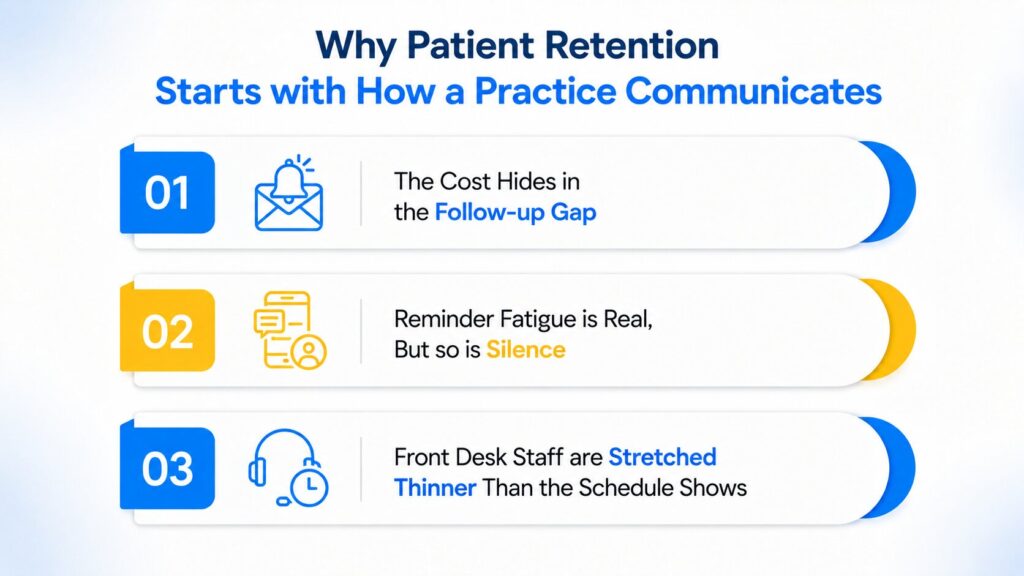
1. The Cost Hides in the Follow-up Gap
Practices tend to measure retention by counting patients who leave outright. That misses the bigger issue. Patients who feel forgotten between visits don’t always file a complaint.
They just stop booking. Patient retention healthcare staffing decisions matter here because the person handling reminders and follow-up calls determines whether that gap ever gets noticed in time to fix it.
2. Reminder Fatigue is Real, But so is Silence
Overloading patients with automated texts can backfire, and plenty of practices have learned that the hard way. Still, going silent between visits is worse.
A medical virtual assistant sits in the middle of that balance, sending reminders that feel personal rather than automated, and following up when a patient goes quiet instead of waiting for them to call.
3. Front Desk Staff are Stretched Thinner Than the Schedule Shows
Even well-staffed clinics tend to prioritize the patient standing in front of them over the one who missed a call three days ago.
That’s not a staffing failure exactly. It’s just how in-person triage works. A dedicated virtual assistant doesn’t have that competing pressure, so the follow-up actually happens.
How a Medical Virtual Assistant Handles the Touchpoints That Keep Patients Coming Back
Retention isn’t one action. It’s a handful of small, repeated tasks that either happen consistently or don’t happen at all.
- Confirming appointments early enough that a patient can reschedule instead of no-showing
- Sending reminders that reference the actual visit type, not a generic template
- Following up within a day or two after a visit to check on next steps
- Answering patient questions about billing, prep instructions, or scheduling without a multi-day delay
- Coordinating between referrals, labs, and the front office so nothing falls through
Each of those, on its own, seems minor. Together, they’re the difference between a patient who feels tracked and one who feels forgotten.
Practices that want to see this in action can look at how a virtual assistant handles day to day administrative load for physicians, which covers the same underlying workload from the provider’s side rather than the patient’s.
Practical Ways a Medical Virtual Assistant Strengthens Patient Loyalty
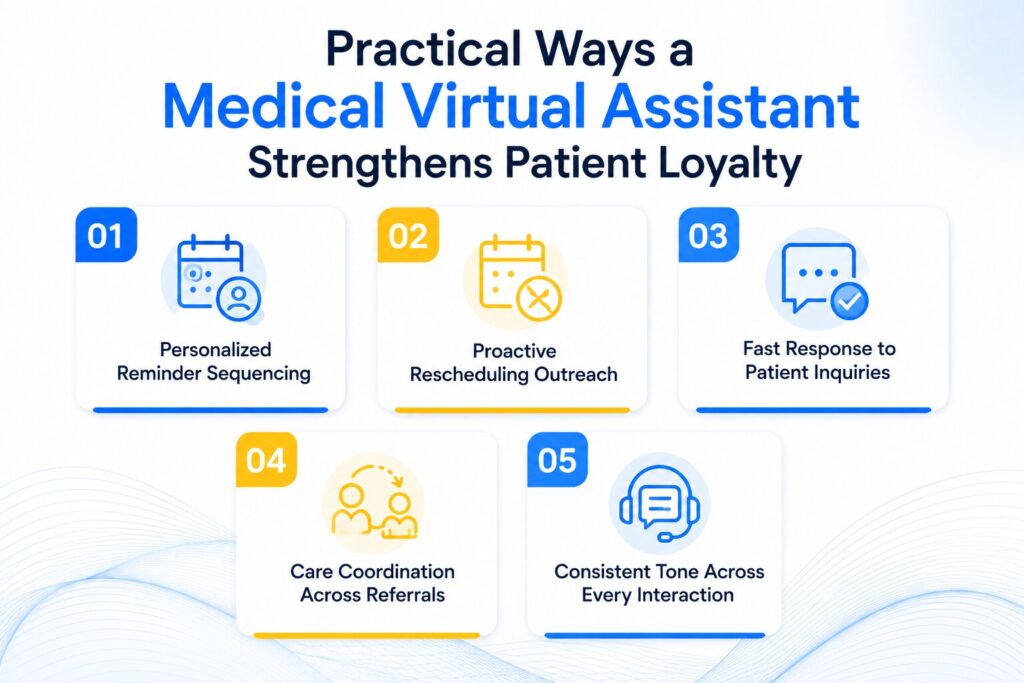
1. Personalized Reminder Sequencing
Instead of one generic reminder text, a virtual assistant can layer reminders based on visit type and patient history. A first-time patient gets more context. A returning patient gets a shorter, familiar nudge.
2. Proactive Rescheduling Outreach
When a patient cancels, most practices wait for them to rebook on their own. A virtual assistant reaches out the same day with two or three open slots, which closes the gap before the patient forgets or finds another provider.
3. Fast Response to Patient Inquiries
Questions about billing, prep, or insurance often sit unanswered for days at busy front desks. Quick, accurate answers keep small frustrations from becoming a reason to leave.
4. Care Coordination Across Referrals
When a specialist visit or lab order gets lost between systems, patients notice, and it damages trust fast. Coordinating that handoff keeps continuity intact.
5. Consistent Tone Across Every Interaction
Patients pick up on inconsistencies between staff members faster than practices expect. A dedicated assistant creates a single, steady voice across scheduling, billing questions, and follow-up.
None of these requires new technology or a bigger budget. They require someone whose job is specifically to handle them, which is exactly the gap a virtual assistant fills.
In-house Front Desk Staff vs a Medical Virtual Assistant for Retention Tasks
| Task | In-house front desk | Medical virtual assistant |
| Appointment reminders | Often automated only, with minimal follow-up | Personalized reminders plus live follow-up |
| Missed appointment outreach | Delayed, competes with walk-in patients | Same-day outreach, no competing priorities |
| Patient inquiry response time | Can lag during peak hours | Consistent turnaround regardless of front desk volume |
| Care coordination | Handled between other duties | Dedicated focus on referrals and follow-up |
| Cost to scale | Requires additional hires and benefits | Scales without added overhead |
The table isn’t a case against the front desk staff. It’s a case for splitting the work so retention tasks don’t get buried under everything else the front desk already handles.
Where Staffing Solutions and Retention Actually Meet
Practices looking to improve patient retention clinic virtual assistant support often assume this means replacing existing staff. It usually doesn’t.
Most clinics layer a virtual assistant on top of their current team to absorb the follow-up and communication work that keeps slipping through the cracks.
That’s a staffing decision as much as a patient experience one, and it tends to pay for itself through fewer missed visits alone. Practices exploring what that setup looks like in practice can review DoctorPapers’ medical virtual assistant services to see how the role is typically structured.
It’s worth saying plainly that results vary by specialty and patient population. A pediatric practice and a cardiology group won’t see identical retention gains from the same virtual assistant setup, since the reasons patients disengage differ by specialty and by how often they need to be seen.
Bringing It Together
Patient retention rarely fails because of one bad experience. It fails through accumulation, missed calls, slow follow-up, and reminders that feel like they came from a machine instead of a person. Medical virtual assistant patient retention support works because it puts a consistent, attentive presence on exactly the tasks that usually get pushed aside during a busy day.
For practices weighing whether to build that support internally or bring in dedicated help, DoctorPapers works with clinics on exactly this kind of staffing setup, matching virtual assistant support to how a practice actually runs day to day.
Frequently Asked Questions
1. Does a medical virtual assistant replace front desk staff entirely?
No. Most practices keep their in-person team and add a virtual assistant to handle the follow-up and communication tasks that otherwise get deprioritized.
2. How quickly do practices see retention improvements?
It depends heavily on current no-show rates and how disorganized the follow-up already was. Some practices notice fewer missed appointments within the first month. Others take a full quarter to see a measurable shift in patient loyalty, especially if the previous process had no consistent follow-up at all.
3. Is patient data safe with a remote assistant?
Yes, as long as the provider is HIPAA trained and uses secure, encrypted systems with role-based access. That’s not automatic, though. Practices need to confirm those safeguards before onboarding, not assume they’re standard.
4. What’s the biggest mistake practices make when trying to improve retention?
Relying entirely on automated reminders and skipping the live follow-up. Automation catches the easy cases. It’s the personal outreach after a missed visit that actually brings patients back.
5. Can a virtual assistant help with billing-related patient questions, too?
Often, yes. Many virtual assistants are trained to handle basic billing and insurance questions directly, which reduces the back and forth that frustrates patients and slows down collections.