

More than half of medical group leaders, 53%, now say finding qualified candidates is their single biggest staffing challenge, according to an MGMA Stat poll from October 2024. That pressure hasn’t eased. Practices facing it often turn to a virtual medical assistant as a faster, cheaper fix, assuming remote hiring skips the usual headaches. It doesn’t. The same shortcuts that produce a bad in-house hire, vague job descriptions, no real skills check, and rushed onboarding show up just as often with virtual staff. Sometimes worse, since there’s no in-person cue to catch a mismatch early.
Whether a practice is exploring medical billing services, broader virtual medical assistant services, or healthcare staffing solutions to shore up revenue cycle management, the hiring step is where most of the value gets won or lost. This piece walks through the mistakes hiring virtual medical assistant teams make most often, and what changes once a practice gets the process right.
Why These Hiring Mistakes Cost More Than They Look Like They Do
A bad virtual assistant hire rarely announces itself in week one. It shows up three weeks later as a missed prior authorization, a patient who never got a callback, or a claim that sat untouched because nobody defined who owned follow-up. By the time a practice manager notices the pattern, the cost has already stacked up in ways that don’t show on a resume review.
The downstream effects tend to hit in a few predictable places:
- Claims were delayed or denied because the intake data wasn’t verified correctly
- Patient complaints tied to missed callbacks or scheduling confusion
- Existing staff absorbing extra work to cover gaps nobody planned for
- Repeated turnover that resets the learning curve every few months
Quick Take: Practices that skip structured screening for virtual medical assistants report roughly three times the early turnover of those using a defined hiring and onboarding process, based on patterns observed across healthcare staffing engagements.
None of this means virtual staffing is risky by nature. It means the hiring process needs the same rigor a practice would apply to an in-office role, arguably more, since there’s less day-to-day visibility into how the work actually gets done.
The Screening Mistakes That Surface Weeks After Onboarding
Screening for a virtual medical assistant looks simple on paper, a resume, a quick call, maybe a skills test. In practice, three gaps keep showing up more than any others, and none of them are obvious until the assistant’s already three weeks into the job.
1. Skipping a Real Healthcare Experience Check
A resume that lists “administrative support” doesn’t tell a hiring manager much. Healthcare has its own vocabulary, its own workflows, its own sense of urgency around things like prior authorization windows and eligibility checks.
A candidate who’s only ever scheduled generic appointments will need weeks to catch up on things a healthcare-trained assistant already knows on day one.
2. Overlooking Communication Skills Until It’s Too Late
This is the mistake that practices notice fastest and fix slowest. Patients can tell within one phone call whether the person on the other end understands them, and whether that person is guessing at terminology they don’t recognize.
Written communication matters too, especially for portal messages and documentation handoffs, where tone and clarity affect how the front desk and the back office stay in sync.
3. Treating HIPAA Compliance Knowledge as Optional
Some practices assume any HIPAA training is sufficient. It usually isn’t specific enough. General privacy training doesn’t cover the reality of handling PHI across EHR platforms, secure messaging tools, and remote work environments where the compliance stakes are genuinely different from an in-office desk.
This is one of those areas where the rule isn’t fixed; requirements can vary depending on the platform, the state, and the specific data being handled, so it’s worth confirming rather than assuming.
The Mistakes That Happen After the Offer Letter Goes Out
Even a strong candidate can turn into a disappointing hire if what happens next is mishandled. These are the five most common breakdowns once someone actually starts the job.
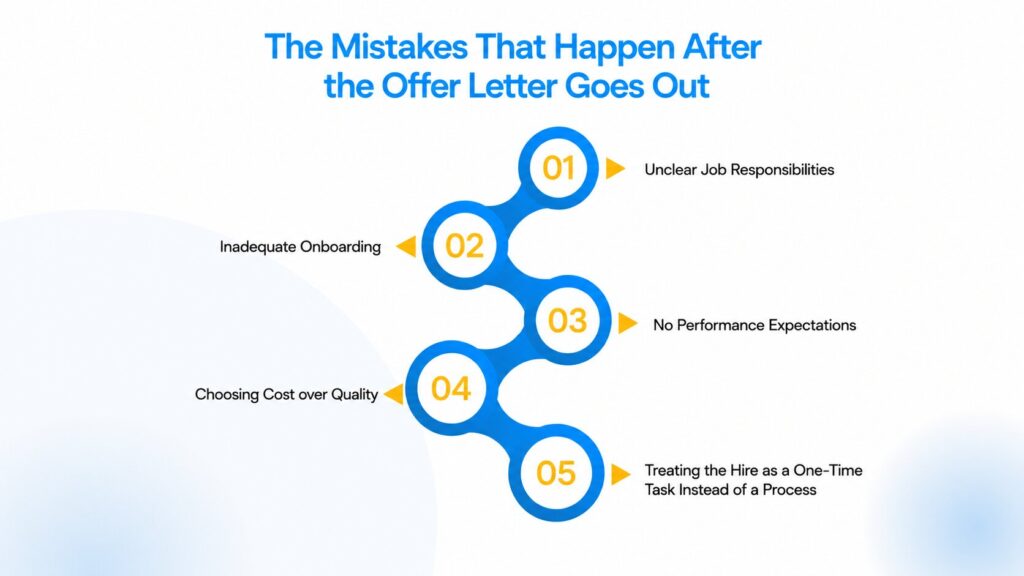
1. Unclear Job Responsibilities
A vague job description leads to a vague employee. If the role wasn’t scoped clearly before the interview, the new hire is left guessing at priorities during their first, most important weeks.
2. Inadequate Onboarding
Dropping someone into live patient calls with a login and a shrug isn’t onboarding. It’s a setup for early mistakes that then get blamed on the hire instead of the process.
3. No Performance Expectations
Without benchmarks, there’s no way to know if a virtual assistant is doing well or quietly falling behind until a patient complaint forces the issue.
4. Choosing Cost over Quality
The cheapest hourly rate almost always costs more once correction time, redone claims, and repeated onboarding get factored in.
5. Treating the Hire as a One-Time Task Instead of a Process
Hiring doesn’t end at the offer. Ongoing check-ins, feedback loops, and periodic skills reviews are what keep a virtual assistant improving instead of stagnating.
How Virtual Medical Assistants Compare to Other Staffing Options
| Staffing option | Healthcare training | HIPAA readiness | Typical ramp-up | Relative cost |
| In-house medical assistant | Strong, but limited by local hiring pool | Usually solid | 2 to 4 weeks | Highest, includes benefits |
| Generalist virtual assistant | Minimal or none | Inconsistent | 4 to 6 weeks | Lowest upfront |
| Healthcare-trained virtual medical assistant | Strong, healthcare-specific | Trained and verified | 1 to 2 weeks | Moderate |
Practices that want to hire healthcare virtual assistant support usually land in that third row once they’ve been through the cost of getting it wrong once already.
How to Hire Medical Virtual Assistant Support Without Repeating These Mistakes
The fix isn’t complicated, though it does require slowing down at the one stage most practices rush. Before posting a role, write down the actual daily tasks the assistant will own, not a generic job title.
During screening, ask for specific examples of handling insurance verification or patient scheduling, not just yes or no answers about experience. Build a short onboarding plan with a defined first two weeks instead of assuming the person will figure it out.
A few practical habits make the biggest difference:
- Test communication skills with a live scenario, not just a written application
- Confirm HIPAA training with documentation, not a verbal assurance
- Set 30 and 60-day performance check-ins from the start
- Budget for a slightly higher rate in exchange for lower turnover
It’s worth saying plainly: most of the friction practices experienced with virtual staffing trace back to skipping one of these steps, not to virtual staffing itself being unreliable.
Conclusion
Getting virtual staffing right isn’t about finding a flawless candidate. It’s about building a hiring process that catches the same problems a practice would catch in person: unclear expectations, weak communication, and thin compliance knowledge, before they turn into patient complaints or denied claims.
Practices that treat the mistakes hiring virtual medical assistant teams commonly make as fixable process gaps, rather than bad luck, tend to see faster ramp-up and far less turnover. DoctorPapers works with practices navigating exactly this kind of hire, and its guide on how a virtual medical assistant helps doctors reclaim time is worth a look for practices weighing whether now’s the right time to bring one on.
Frequently Asked Questions
1. Is hiring a virtual medical assistant riskier than hiring in-house staff?
Not inherently. The risk comes from applying a looser hiring process simply because the role is remote.
2. How long should onboarding take for a new virtual medical assistant?
Most practices see solid independence within one to two weeks when onboarding includes shadowed calls, a documented task list, and daily check-ins during the first few days. Practices that skip structured onboarding often see that timeline stretch to a month or longer, with mistakes surfacing the whole way through.
3. What’s the biggest red flag during the interview stage?
Vague answers about past healthcare experience. If a candidate can’t describe a specific scenario, like handling an insurance verification error, they probably haven’t done it.
4. Do virtual medical assistants need the same HIPAA training as in-office staff?
Yes, and honestly, the training needs to go further in some respects, since remote work introduces additional questions around device security and data access that an in-office role doesn’t face in the same way.
5. Can a smaller practice manage without a full hiring process for virtual roles?
It’s possible, but risky. Smaller practices actually feel hiring mistakes faster because there’s no backup coverage when a new hire underperforms. A lighter process is fine. No process at all usually isn’t.