


A denial lands in the queue with no explanation beyond a generic code, and the visit note behind it looks solid at first glance. Then someone notices the procedure billed doesn’t quite match what the physician wrote. That gap is the entire reason billers lean on one unofficial rule more than any coding manual. Ask a biller who has worked a denials queue for more than a year, “what is the golden rule in medical billing?” and the answer usually sounds the same: if it isn’t documented, it wasn’t done, and if it wasn’t done, it can’t be billed. That single idea sits underneath golden billing at every well-run practice, and it explains why well-run practices often report clean claim rates in the mid-90s, while less consistent ones land somewhere in the 70s.
The Principle Every Clean Claim Depends On
The golden rule didn’t come from a payer handbook or a CMS manual. It grew out of decades of audits and billing teams who kept losing cases they thought were airtight. The rule itself is short.
A service can only be billed if the medical record proves it happened and proves it was necessary. Nothing complicated about that. But ignoring it rarely stays simple for long.
Practices that skip this step rarely find out right away. A missing detail almost never gets flagged at the point of service. It surfaces weeks later, buried inside a denial explanation nobody has time to unpack.
According to a March 2024 MGMA Stat poll, practice leaders whose claim denials had increased or remained steady most commonly cited three drivers: insufficient documentation identified by payers, patient eligibility or identification-number errors, and untimely filing.
Modifier mistakes, EHR transition issues, and authorization gaps rounded out the list. Documentation keeps showing up in denial data because it’s the one variable a practice controls.
This is where golden billing stops being an abstract phrase and becomes a daily habit. It shapes how a front desk collects information, how a physician charts an encounter, and how a coder decides which code fits. Skip a step anywhere in that chain and the claim inherits the weak link.
How Golden Billing Works in Practice
Consider a follow-up visit for a chronic condition, where the physician adjusts medication and orders labs. If the note reads only “follow up, doing okay,” a coder has almost nothing to work with.
No status update, no rationale for the lab order, no clear link between what was billed and what was documented. That claim is vulnerable the moment it leaves the building.
Now picture the same visit charted properly, with current symptoms, medication response, and a stated reason for each lab ordered.
Suddenly the claim has a foundation. If it gets audited eighteen months from now, the record still tells the same story it told on day one. That consistency is what keeps golden billing habits intact under pressure.
It’s worth admitting this isn’t always a fixed formula. Documentation expectations shift by payer, by plan type, and occasionally by the reviewer handling an appeal.
What satisfies one commercial plan’s medical necessity criteria won’t always satisfy Medicare’s. This is why most practices write their own medical documentation guidelines, tailored to their specialty and payer mix, instead of relying on a generic template.
The same logic applies to keeping provider credentialing current, since a lapsed enrollment can trigger a denial that has nothing to do with how the visit was charted.
Read more; how to choose the right credentialing services
Why Organized Records Shorten Every Appeal
Good documentation only helps if someone can find it later. A perfectly worded note buried three tabs deep in an EHR does a coder no good when they’re racing toward a submission deadline. This is where medical record documentation requirements meet something more practical: how the chart itself is built.
1. Structuring the Chart so Coders Don’t Guess
The best way to organize medical records usually comes down to consistency, not any particular software feature. Encounter notes, orders, and supporting documentation should live in predictable places, tagged the same way regardless of which provider saw the patient. A coder who has to hunt across five sections to confirm medical necessity will make more mistakes, not fewer.
2. Keeping Records Audit-Ready Year-Round
When medical records are organized around the claim lifecycle rather than convenience for whoever typed the note, appeals move faster. A denial that would normally take a coder twenty minutes to research might take five, since the supporting documentation sits where the workflow expects it. Multiply that across a few hundred denials a month and the hours add up fast.
Habits That Keep Billing Golden
A handful of habits separate practices with strong first pass rates in medical billing from practices constantly fighting denials. None of them require new software, just consistency applied every day.
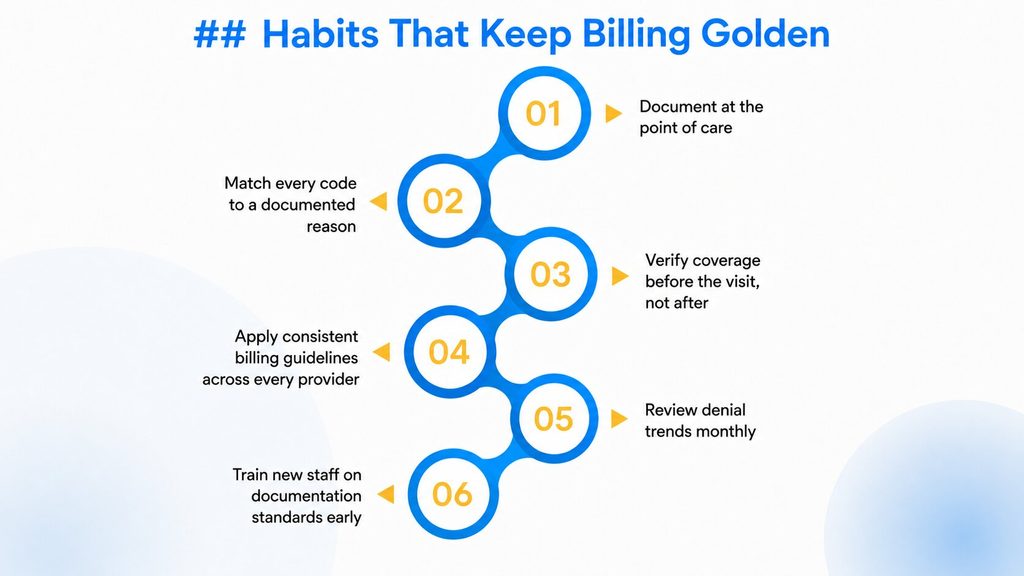
- Document at the point of care: Notes written from memory hours later lose detail, and that detail protects a claim during an audit.
- Match every code to a documented reason: A procedure code with no supporting rationale in the chart is a denial waiting to happen, even if the service itself was appropriate.
- Verify coverage before the visit, not after: Confirming eligibility upfront through insurance eligibility verification catches problems while there’s still time to fix them.
- Apply consistent billing guidelines across every provider. Two physicians documenting the same condition two different ways creates confusion for coders and auditors alike.
- Review denial trends monthly: Patterns repeat. A practice that never looks back at why claims failed keeps making the same mistakes.
- Train new staff on documentation standards early: Bad habits formed in the first few weeks tend to stick around for years.
Documentation Gaps That Quietly Break the Rule
Some gaps are obvious. Others hide in plain sight until an audit or a denial forces a closer look.
| Documentation gap | How it usually shows up | Typical impact |
| Vague progress notes | “Doing well, continue plan” with no specifics | Coder guesses at severity, risking under- or over-coding |
| Missing medical necessity language | Test ordered without a stated clinical reason | Frequent denials tied to necessity requirements |
| Inconsistent provider documentation | Different formats or detail levels across physicians | Slower coding, more clarification requests |
| Delayed chart completion | Notes finalized days after the visit | Details fade, increasing audit risk |
| Disorganized record structure | Supporting documentation scattered across the chart | Longer appeal turnaround, missed deadlines |
It’s worth admitting, the practices that struggle most aren’t always the smallest ones. Larger groups with multiple EHR templates sometimes create more inconsistency than a single physician working from one format, simply because more hands touch the chart.
None of this replaces accurate medical coding. A well-documented chart still needs a coder who understands the payer’s rules and applies them correctly.
Treating either one as sufficient on its own is how practices end up with insurance claim documentation that looks complete but still gets denied.
A denial management team can catch some of this after the fact, but closing the gap before the claim leaves the building is cheaper.
Healthcare billing compliance depends on this pairing holding steady across every visit, not just the complicated ones. It’s often the routine, unremarkable encounters where documentation habits slip first.
Frequently Asked Questions
1. What happens if a claim is billed without proper documentation?
The claim is at risk of denial, recoupment, or an audit finding, even if the service was medically appropriate and performed exactly as billed.
2. Is the golden rule the same as medical necessity?
Not exactly. Medical necessity is one part of what documentation needs to prove. The rule also covers accuracy and timing, not just that a service happened. Billing and coding guidelines from most payers treat these as related but separate requirements.
3. How does documentation affect the reimbursement timeline overall?
Reimbursement depends on what the payer can verify from the record, and weak documentation slows every stage of the healthcare reimbursement process, from adjudication through any appeal.
4. Do small practices need the same documentation standards as hospitals?
Yes, though the supporting systems look different. A solo physician can maintain strong documentation without the layered software a hospital uses, as long as the habits are consistent.
5. Can outsourcing medical billing fix documentation problems?
It helps, but it isn’t a complete fix. A partner handling medical billing services can catch gaps before submission and flag patterns worth addressing with providers, though the charting still happens inside the practice.
Keeping the Rule Intact
The golden rule in medical billing isn’t a compliance checkbox or a phrase for a training slide. It’s the difference between a claim that survives scrutiny and one that quietly becomes a write-off six months later.
Documentation, organization, and coding accuracy all feed into the same outcome, and none of them work well in isolation.
Practices that treat golden billing as a daily discipline, not an occasional audit prep exercise, tend to see it show up directly in their collection rates.
DoctorPapers works with practices on exactly this kind of documentation and coding alignment, helping billing teams catch gaps before they turn into denials rather than after.
If your denial queue has been growing lately, it might be worth a closer look at where the documentation trail breaks down.