
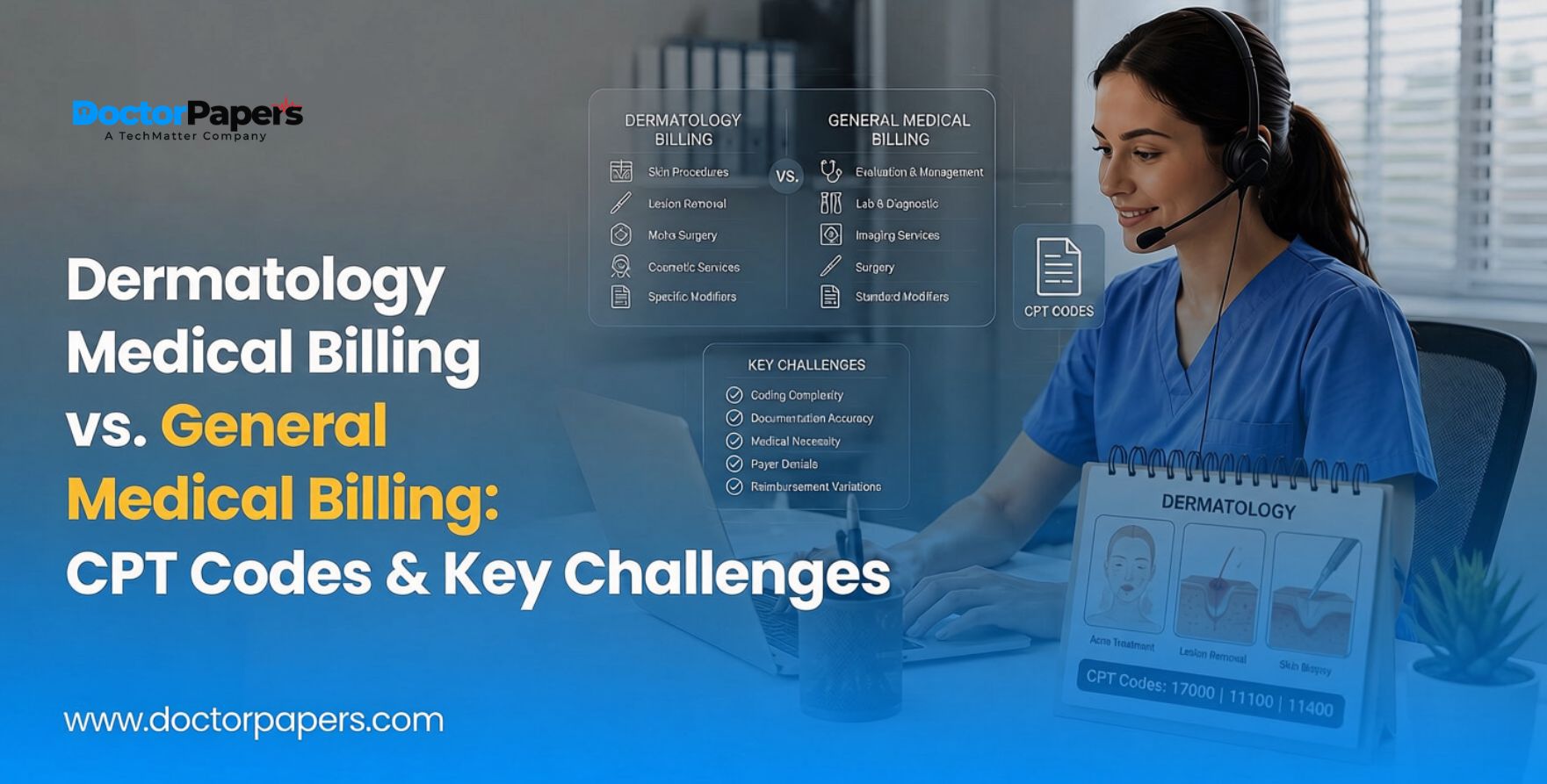

Payers process dermatology claims through the same clearinghouse pipes as every other specialty, yet billers often report denial letters arriving faster and more often. Ask a biller who has moved from a family practice caseload to a dermatology one, and they will tell you the coding rules did not change gently. They changed completely. The American Medical Association’s CPT 2026 code set, released in 2025, added 288 new codes and 418 total changes across the coding system, and dermatology appears to touch more of those procedural families than most outpatient specialties, given how many code sets tie directly to lesion work. That volume is exactly why dermatology medical billing vs. general medical billing comparisons keep coming up in staff meetings. The two are not variations on a theme. They are different disciplines wearing the same paperwork.
What Makes Dermatology Medical Billing vs. General Medical Billing Different
Start with volume. A single office visit might include a full skin check, two biopsies, cryotherapy on a handful of actinic keratoses, and a shave removal, each carrying its own procedure code and documentation rule. General billing teams are used to one or two line items per encounter.
Derm billers are used to five or six, and every one carries its own justification. That’s what surprises staff who transfer in from primary care billing.
Dermatology isn’t harder to understand conceptually. The density of coding decisions per visit just multiplies the chance that something gets missed.
This density is why dermatology medical billing and coding typically calls for staff trained specifically in the specialty rather than generalists rotating through it, which is part of why many practices lean on dedicated medical billing services built around specialty knowledge.
Lesion size, location, count, and type all change which code applies, and none of that shows up automatically in an EHR template. Someone has to measure and document it at the time of the procedure.
Pathology adds another layer whenever a biopsy gets sent out, since the report has to tie back to the original claim before coding happens. And then there are modifiers, which dermatology leans on more heavily than most fields because so many visits pair an evaluation with a procedure on the same day.
Medical vs. Cosmetic Dermatology Billing
Dermatology coding hinges on a distinction that barely exists in most other specialties: whether a service was medically necessary or purely cosmetic.
Acne treatment tied to a diagnosed inflammatory condition gets billed to insurance. A filler injected purely for appearance does not, and billing it as though it were medically necessary is the kind of decision that draws payer audits.
Patients rarely understand this distinction going in, which is its own quiet source of billing disputes that has nothing to do with coding accuracy at all.
| Category | Medical dermatology | Cosmetic dermatology |
| Purpose | Treats a diagnosed condition | Primarily addresses appearance |
| Insurance | May be covered | Usually paid by the patient |
| Documentation | Requires medical necessity | Requires clear pricing and payment terms |
| Examples | Psoriasis, skin cancer evaluation, medically necessary lesion removal | Cosmetic Botox, fillers, elective procedures |
Acne, psoriasis, and suspicious lesion evaluations sit clearly on the medical side. Elective Botox and dermal fillers sit on the cosmetic side.
The harder cases live in between, like a lesion removal where the note doesn’t clearly establish why it needed to come off.
That ambiguity is where claims get denied, not because the coder picked the wrong number, but because the note behind the number didn’t support it.
Common CPT Codes Used in Dermatology Billing
Cpt codes for dermatology claims spans several sections of the CPT book, but most practices live inside a fairly predictable set.
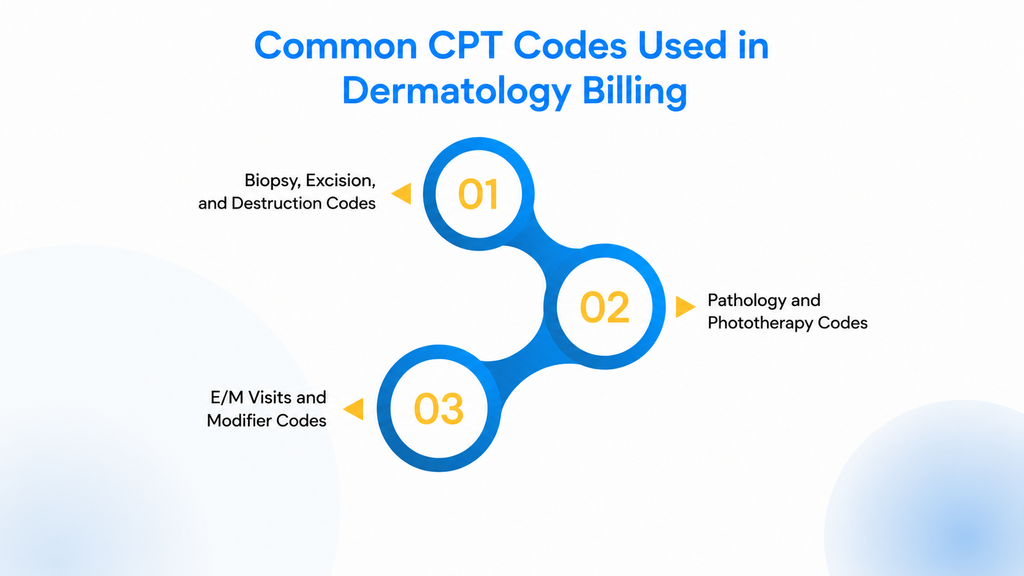
1. Biopsy, Excision, and Destruction Codes
Biopsy codes cover tissue sampling and are billed by technique rather than diagnosis: tangential, punch, or incisional, with add-on codes for each additional lesion beyond the first. Excision codes are size-based and apply when the entire lesion comes off rather than a sample.
Destruction codes cover lesions removed through freezing, laser, or electrosurgery, and these three families get confused with each other constantly because the procedures can look similar from the outside.
Derm cpt codes in these families are where lesion count and location documentation carry the most weight, since payers cross-check the number of lesions billed against what the operative note describes.
2. Pathology and Phototherapy Codes
Whenever a biopsy specimen heads to pathology, codes like 88305 cover the technical and professional read, and a missing or incomplete pathology report is one of the fastest ways to see that portion of a claim denied.
Phototherapy runs on its own separate codes too, billed per treatment session rather than per visit, and payers often cap how many sessions they’ll cover within a benefit period. Practices that don’t track session counts closely tend to find out about that cap only after a claim already bounces.
3. E/M Visits and Modifier Codes
Office visits use the same 99202 through 99215 range as any other specialty, but dermatology pairs them with a procedure far more often than internal medicine or cardiology typically do.
That pairing is what pulls modifier 25 into daily use, since it tells the payer a separate, identifiable evaluation happened alongside the procedure on the same date.
Dermatologist cpt code selection at the E/M level depends on medical decision-making or total time, and either pathway needs support in the note, not assumption from habit.
Documentation Gaps That Trigger Dermatology Billing Denials
Coding differences aside, documentation carries more weight in derm than almost anywhere else in outpatient medicine.
Dermatology medical billing breaks down most often at five predictable points, and none of them are exotic. For a broader look at how denials move through a practice, this guide to denial management in healthcare covers the mechanics in more depth.
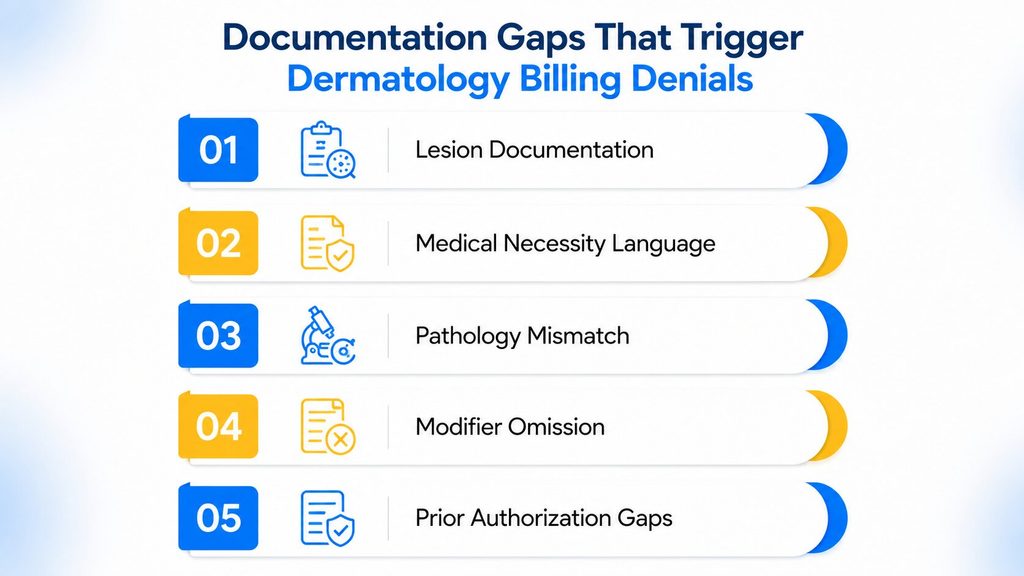
1. Lesion Documentation
Missing size, count, or location on the note before anesthesia is applied. Coders can’t select the right code without a measurement, and the guess that fills the gap is often wrong.
2. Medical Necessity Language
A chart that never states why a lesion needed removal, leaving the claim looking cosmetic even when it wasn’t.
3. Pathology Mismatch
A diagnosis code that doesn’t align with what came back from the lab, one of the fastest ways to trigger a payer review.
4. Modifier Omission
E/M and procedure billed on the same day without modifier 25 attached, so the payer bundles the visit and pays for only one service. Catching this at the denial management stage recovers some of that lost revenue, though preventing it up front is cheaper.
5. Prior Authorization Gaps
Certain treatments and medications need approval before the appointment. Confirming coverage through insurance eligibility verification before the visit matters as much as the coding itself, since a missed authorization turns an otherwise clean claim into an automatic denial.
How to Strengthen Dermatology Billing Accuracy
Practices that keep denial rates low share a few habits. They use coders trained specifically in dermatology rather than general surgical coding. They review CPT and ICD-10 updates every year instead of running on last year’s superbill.
They verify insurance before the appointment rather than after the claim bounces, and many pair this with credentialing services to keep both processes aligned as new providers join.
They also audit the highest-risk procedure codes on a regular schedule rather than waiting for a pattern to show up in the AR report.
None of this is complicated. It just requires consistency that’s easy to let slip when a front desk is short-staffed.
Good medical billing for dermatology comes down to workflow discipline more than any single coding trick, though no workflow eliminates denials completely. Payer policies shift by plan and by year, and even well-run practices see some claims bounce back.
Conclusion
None of this means dermatology billing is impossible to manage in-house, but it does mean the margin for error runs thinner than in most specialties. The comparison between dermatology medical billing vs. general medical billing isn’t really about which one is harder in the abstract.
It’s about recognizing that derm claims need coders who live in this specialty daily, not ones who treat it as a side responsibility. DoctorPapers works with dermatology practices on this kind of specialty-specific coding and denial management, helping keep clean claim rates high without adding administrative weight to the front desk.
If your practice has been absorbing more denials than it should, a closer look at where the documentation gaps sit is usually the fastest place to start.
Frequently Asked Questions
1. What is dermatology medical billing?
It’s the process of coding and submitting claims for skin-related medical and surgical services, from office visits and biopsies to excisions and Mohs surgery. The specialty piece comes from how tightly the coding depends on lesion detail and documentation.
2. Why is dermatology billing different from general medical billing?
Because a single visit routinely generates several billable services instead of one, and payer rules for modifiers, bundling, and medical necessity run stricter in this specialty than in most others.
3. Are cosmetic dermatology services covered by insurance?
Rarely, and mostly no. Insurance excludes procedures performed for appearance alone, though the line blurs when a service has both a medical and a cosmetic component, like removing a lesion that’s both irritating and unsightly. Coverage then depends on how well the medical necessity gets documented, not on the procedure itself.
4. What are the most common dermatology billing codes?
Biopsy codes, destruction codes for premalignant and benign lesions, excision codes, and E/M visit codes make up the bulk of daily claims. Anyone researching cpt codes dermatology references usually lands on these four families first, since together they cover most of what a general dermatology practice bills week to week.
5. Do dermatology procedures require prior authorization?
Sometimes. It depends entirely on the payer, the plan, and the specific procedure or medication involved, so there’s no universal rule to memorize here. Practices that skip verification on anything resembling a gray area tend to pay for it later in denied claims.