

Payers reject more claims over code selection than almost any other single issue, and it’s rarely a knowledge gap. It’s a mix-up between two systems that look similar on the surface but do very different jobs. Get the cpt code vs hcpcs question wrong on a claim, and a service that was performed correctly still comes back denied. CPT codes describe what a provider does. HCPCS fills in the supplies, drugs, and equipment CPT was never built to capture. The January 2026 HCPCS Level II update alone added 78 new M codes tied to documentation requirements, which says something about how often this code set shifts under a biller’s feet.
This guide walks through where each system starts, where they overlap, and how to stop the mix-ups that quietly drain reimbursement.
HCPCS vs CPT Codes at a Glance
Before getting into the weeds, it helps to see both systems next to each other. The table below covers the basics of HCPCS vs. CPT codes at a glance, including where primary care CPT codes fit into everyday billing, and it’s worth pairing with a closer look at how these codes actually drive reimbursement in day-to-day visits.
| Feature | HCPCS | CPT |
| Full form | Healthcare Common Procedure Coding System | Current Procedural Terminology |
| Maintained by | CMS | American Medical Association (AMA) |
| Code format | Level I (numeric), Level II (alphanumeric) | Five-digit numeric |
| Primary purpose | Supplies, drugs, DME, ambulance, some services | Medical, surgical, and diagnostic procedures |
| Common users | Medicare, Medicaid, commercial payers | All healthcare providers |
That’s the skeleton. The details, and the parts that actually trip up billing teams, live underneath it.
What are CPT Codes?
CPT codes are five-digit numeric codes that describe medical, surgical, and diagnostic services performed by a provider. The AMA developed the system and still owns it, updating the code set every year to keep pace with new procedures and retiring ones that no longer apply. There are three categories.
- Category I covers the everyday codes most practices use constantly, office visits, surgeries, lab work.
- Category II codes are supplemental and track performance measures rather than billable services.
- Category III codes are temporary, assigned to emerging technology or procedures that haven’t earned a permanent Category I code yet.
A difference between cpt and hcpcs codes worth remembering here is that CPT stays entirely numeric, no letters mixed in, which is one of the fastest ways to tell them apart on sight.
For a closer look at how a single injection code works, read this guide to CPT code 96372. Documentation, modifiers, and the ICD-10 pairing all have to line up.
Common examples include 99213 for an established patient office visit and 93000 for a routine electrocardiogram.
What are HCPCS Codes?
HCPCS exists because CPT doesn’t cover everything a claim needs to report. CMS built it to fill that gap, and it’s the coding system Medicare and Medicaid lean on most heavily.
HCPCS splits into two levels. Level I is identical to CPT, numeric, physician-focused, maintained through the same AMA process.
Level II is where things get distinct: alphanumeric codes, one letter followed by four numbers, covering durable medical equipment, injectable drugs, ambulance transport, prosthetics, and supplies.
A wheelchair doesn’t have a CPT code because CPT was never designed to bill equipment. That’s a hcpcs codes vs cpt distinction that matters the moment a DME claim crosses a biller’s desk.
Examples of HCPCS Level II codes include A4253 for blood glucose test strips and E0114 for crutches.
HCPCS vs CPT: Key Differences
The comparison above gets more specific once you factor in payer behavior and update cycles.
| Feature | HCPCS | CPT |
| Maintained by | CMS | AMA |
| Code structure | Alphanumeric (Level II) | Numeric |
| Used for | Supplies, DME, drugs, ambulance | Physician procedures |
| Primary payer | Medicare and Medicaid | Commercial and government payers |
| Annual updates | Yes | Yes |
Cpt code vs hcpcs decisions often come down to one question: is this a service a provider performed, or an item and supply attached to that service? Get that framing right, and most of the confusion clears up on its own.
It doesn’t always feel that clean in practice, though, especially when a claim involves both.
HCPCS Level I vs. HCPCS Level II
This is the piece a lot of guides gloss over, and it’s where a fair number of coding errors actually start.
HCPCS Level I is CPT. Not similar to CPT, not derived from CPT, it is CPT, adopted into the HCPCS structure so Medicare has one consistent framework for physician services. Numeric, five digits, same rules.
Level II is the alphanumeric layer built for everything CPT skips: injectable and infused drugs, DME like wheelchairs and hospital beds, ambulance transport, prosthetics and orthotics, and general medical supplies.
A hcpc vs cpt comparison at this level really comes down to scope. CPT bills the service. Level II bills the physical item or the transport.
| Level | Code format | Used for |
| HCPCS Level I | Five-digit numeric (same as CPT) | Physician services and procedures |
| HCPCS Level II | One letter + four digits | Supplies, DME, drugs, ambulance, prosthetics |
When Should You Use HCPCS Codes vs CPT Codes?
Office visits, surgical procedures, and most diagnostic work bill under CPT. That covers the bulk of what a typical practice reports day to day.
HCPCS Level II steps in for drug administration billing (the drug itself often needs a J-code even when the injection procedure carries a CPT code), durable medical equipment, ambulance transport, and orthotics or prosthetics.
Medicare-specific billing leans on HCPCS more heavily than commercial payers do, partly because CMS built the system in the first place.
Answering what is the difference between cpt and hcpcs codes in practice usually means asking who performed the service and whether an item changed hands along with it.
Can HCPCS and CPT Codes be Used Together?
Yes, and it happens constantly. A patient visit that includes an injectable medication is the textbook example: CPT reports the administration, HCPCS reports the drug itself. Neither code replaces the other because neither one describes the full picture alone.
The risk shows up when billers report the same component twice, once under each system, instead of splitting the roles correctly.
Cpt / hcpcs pairing works fine as long as each code carries only its own piece of the claim. Documentation needs to support both halves clearly, or a payer will flag it as duplicate reporting, which is the same coordination breakdown that shows up in most preventable claim denials, even when the billing intent was correct.
Getting the split right the first time also keeps payment posting clean, since a single claim with two mismatched codes tends to post as two separate problems instead of one resolved payment.
Common Billing Mistakes and How to Avoid Them
Most of the denials tied to these two systems trace back to a short list of repeat offenders.
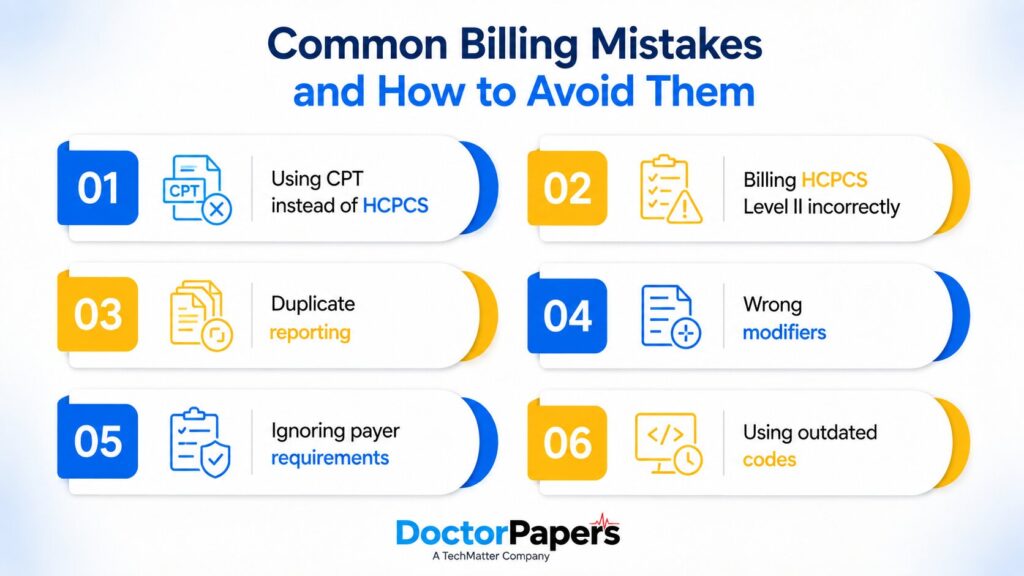
- Using CPT instead of HCPCS: This happens most often with supplies and equipment, where a biller defaults to a familiar CPT-style code instead of checking whether a Level II code actually applies.
- Billing HCPCS Level II incorrectly: Wrong units, wrong drug dosage on a J-code, or a supply code that doesn’t match what was actually provided.
- Duplicate reporting: Reporting the same service under both a CPT and a HCPCS code when only one applies, usually a sign the biller wasn’t sure which system owned that piece of the claim.
- Wrong modifiers: A correct code with the wrong modifier attached still triggers a rejection, and payers rarely explain which part failed.
- Ignoring payer requirements: Some commercial payers accept CPT for services Medicare requires under HCPCS. Assuming one payer’s rules apply everywhere causes more denials than people expect.
- Using outdated codes: Both systems update every year. A code that worked in December can be deleted or revised by January, and claims submitted with stale codes get bounced regardless of how accurate the service description was.
A difference between cpt and hcpcs worth flagging here: HCPCS Level II updates quarterly in some categories, not just annually, so the update cadence itself catches teams off guard.
Real world Coding Examples
A standard office visit for an established patient bills under CPT 99213. No HCPCS code is needed because no separate item or supply is involved, just the provider’s evaluation and management work.
A wheelchair supplied to a patient bills under HCPCS, something like K0001 for a standard manual chair. CPT doesn’t apply here because there’s no procedure being performed, only equipment being provided.
A physician visit that includes an injectable medication needs both. CPT reports the administration procedure, HCPCS reports the drug itself through its hcpcs cpt code, and both appear on the same claim because they describe two separate, billable pieces of the encounter.
Common HCPCS and CPT Code Examples
| Service | CPT | HCPCS |
| Office visit | 99213 | — |
| Influenza vaccine | CPT administration code | HCPCS product code (payer-dependent) |
| Wheelchair | — | K0001 |
| Ambulance transport | — | A0428 |
| Drug administration | CPT + HCPCS drug code | Both may apply |
Knowing that cpt/hcpcs codes are used to cover different halves of the same encounter, rather than competing for the same line item, makes this table easier to read at a glance.
Best Practices for Accurate Coding
Verify payer guidelines before assuming a code set applies universally, since Medicare, Medicaid, and commercial payers don’t always agree.
That verification starts earlier than most people think, often at confirming a patient’s coverage and benefits before the visit even happens.
Keep code books and billing software current, and build a habit of reviewing annual coding changes before they take effect rather than after a batch of denials shows up. Every code needs documentation behind it that clearly supports medical necessity.
Regular coding audits catch drift before it becomes a pattern, and ongoing staff training keeps the whole team working from the same current information instead of last year’s rules.
FAQs
1. What is the difference between HCPCS and CPT?
CPT describes procedures and services a provider performs. HCPCS, specifically Level II, covers supplies, equipment, drugs, and transport that CPT doesn’t address.
2. Are CPT codes part of HCPCS?
Yes. CPT makes up HCPCS Level I. They’re the same numeric codes, just adopted into the broader HCPCS framework for Medicare’s purposes.
3. Who maintains HCPCS codes?
CMS maintains HCPCS Level II. Level I, since it’s identical to CPT, follows the AMA’s maintenance and update process instead.
4. Can HCPCS and CPT codes be billed together?
Often, yes, and it’s expected on claims involving drug administration or any encounter that combines a service with a supplied item. The key is making sure each code reports its own distinct piece rather than overlapping with the other.
5. How often are HCPCS and CPT codes updated?
Both update annually at minimum. HCPCS Level II also sees quarterly updates in certain categories, so relying on a once-a-year review alone isn’t quite enough. It varies depending on the code category and how CMS structures that year’s release.
Conclusion
CPT and HCPCS aren’t competing systems. They’re built to work side by side, one covering what a provider does and the other covering what gets supplied or transported along the way.
Getting CPT code vs HCPCS right on the front end means fewer denials, cleaner claims, and reimbursement that shows up closer to on time.
Coding accuracy isn’t a one-time fix either. It’s something practices have to keep current with as both code sets update.
That ongoing maintenance is where having the right support can make a difference, and it’s part of what DoctorPapers helps practices stay on top of, from catching coding gaps to keeping claims from turning into avoidable denials.
If your team keeps running into rejected claims over code selection, it might be worth a second look at where CPT and HCPCS are getting crossed on your most common services.