

Running a medical practice takes a lot more than seeing patients. Between managing appointments, sorting through insurance paperwork, chasing unpaid claims, and keeping records up to date, the to-do list never seems to end. That is where medical virtual assistant tasks are making a real difference for practice owners and managers across the country.
A Medical Virtual Assistant (MVA) is a trained remote professional who handles the day-to-day administrative and operational work of a healthcare practice. Unlike a regular virtual assistant, an MVA understands medical terminology, knows how to work inside EHR systems, and follows HIPAA rules. They do the same work as an in-office staff member would, just remotely and at a fraction of the cost.
According to the Centers for Medicare & Medicaid Services (CMS), Medicare processed more than 1.1 billion fee-for-service claims in FY 2021. That alone highlights just how large the administrative load is in healthcare, and why more practices are turning to virtual support.
For healthcare practice owners and managers, the question is no longer whether to consider virtual support, but which tasks to delegate first.
Below is a detailed overview of 10 core responsibilities an MVA can take off your plate.
Core Tasks of a Medical Virtual Assistant
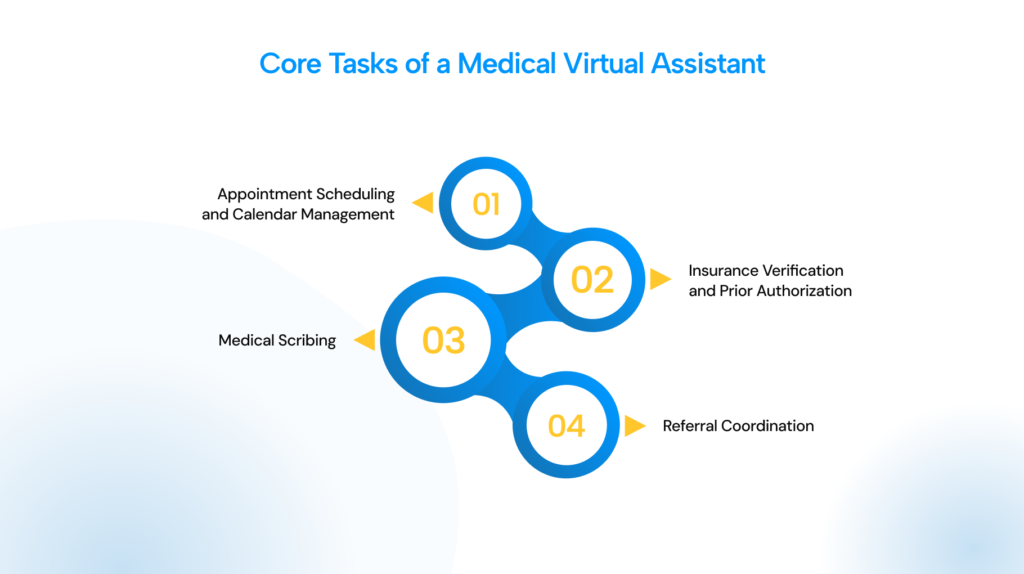
The administrative tasks handled by a medical virtual assistant are often the first area where practices see noticeable improvement.
Their core responsibilities typically fall into three main areas, including patient coordination, clinical documentation support, such as updating records and assisting with charting, and operational support. Some MVAs also bring clinical experience, which further strengthens documentation accuracy and workflow efficiency.
Beyond these functions, they help reduce routine workload so providers can focus more on patient care, where their attention is most needed.
1. Appointment Scheduling and Calendar Management
One of the most time-consuming front office jobs is managing the schedule. An MVA handles new bookings, cancellations, reschedules, and patient reminders across multiple providers. They follow your scheduling rules exactly, so nothing falls through the cracks.
Sending reminders 24 to 72 hours before an appointment helps cut down on no shows, which cost U.S. healthcare practices billions in lost revenue every year. A trained MVA can handle a high volume of daily patient calls, depending on your practice size, turning what is often a chaotic phone queue into a smooth, predictable process.
2. Insurance Verification and Prior Authorization
Checking insurance coverage before a patient arrives is one of the best ways to avoid claim denials and billing headaches later. An MVA confirms coverage details, checks copay amounts, handles referral requirements, and submits prior authorization requests, which can take anywhere from 3 to 7 days for routine cases.
When this is done 24 to 48 hours before each visit, your billing team gets clean information, and your front desk is not scrambling at check-in.
3. Medical Billing Support and Claims Processing
Even small billing errors can lead to delayed payments or denied claims. MVA-trained individuals in medical billing software help prepare and submit claims, follow up on unpaid balances, and flag denied claims for review.
They work alongside your billing team to keep revenue flowing and reduce the number of errors that slip through.
4. Patient Communication Management
Patients expect quick, clear answers whether they are calling, emailing, or sending a message through your patient portal. An MVA monitors all incoming messages, responds to routine questions, and passes clinical concerns on to your in-house team right away.
Prompt replies through secure channels go a long way toward building patient trust and keeping your clinical staff focused on care rather than inbox management.
5. Medical Scribing
A remote medical scribe joins patient encounters, whether in person or via telehealth, and documents everything in real time. That includes symptoms, diagnoses, treatment plans, and physician notes, all entered directly into your EHR while the visit is happening.
This means the provider can focus fully on the patient instead of typing notes the entire time. Documentation overload is one of the biggest drivers of physician burnout, and scribing support directly addresses that problem.
6. EHR Data Entry and Record Management
Patient records need to be accurate, current, and easy to access. MVAs enter medical histories, diagnostic codes, lab results, and referral information into EHR platforms carefully and consistently.
They also flag any errors or missing information for review, which keeps your records clean and reduces risk during audits.
7. Referral Coordination
Getting a patient referred to a specialist involves a lot of moving parts. The MVA handles the paperwork, tracks where the referral stands, follows up with specialist offices, and keeps the patient informed throughout the process.
For practices that deal with complex cases or work within HMO networks, this kind of coordination can save hours every single week.
8. Revenue Cycle Management Support
An MVA can help your billing team by tracking claim submissions, watching for denial patterns, pulling accounts receivable reports, and helping patients understand their bills.
They also keep an updated record of payer requirements and reimbursement policies, so your team always has the right information on hand. The result is a more predictable cash flow and fewer revenue gaps that go unnoticed for weeks.
9. HIPAA Compliance and Documentation Tracking
Professional MVAs are trained in HIPAA rules, use secure platforms, and sign confidentiality agreements before touching any patient data.
They also help your practice stay on top of things like provider credentialing renewals, enrollment deadlines, and payer guideline updates. For growing practices with limited admin staff, this kind of oversight is genuinely valuable.
10. General Practice Administration and Reporting
From generating monthly performance reports to managing vendor contacts and organizing internal communications, an MVA can take on the broader administrative work that keeps a practice organized.
This is where a good MVA stops being just a task handler and becomes a real operational partner for your management team.
Quick Reference: Task and Impact
| Task | Type | Key Benefit |
| Appointment Scheduling | Administrative | Fewer no-shows |
| Insurance Verification | Administrative | Fewer claim denials |
| Billing Support | Financial | Steadier cash flow |
| Patient Communication | Administrative | Higher satisfaction |
| Medical Scribing | Clinical | Less provider burnout |
| EHR Data Entry | Clinical | Accurate records |
| Referral Coordination | Administrative | Saved coordination time |
| RCM Support | Financial | Reduced revenue loss |
| Compliance Tracking | Regulatory | Lower compliance risk |
| Practice Administration | Operational | Better daily workflows |
The Benefits of Hiring a Virtual Medical Assistant
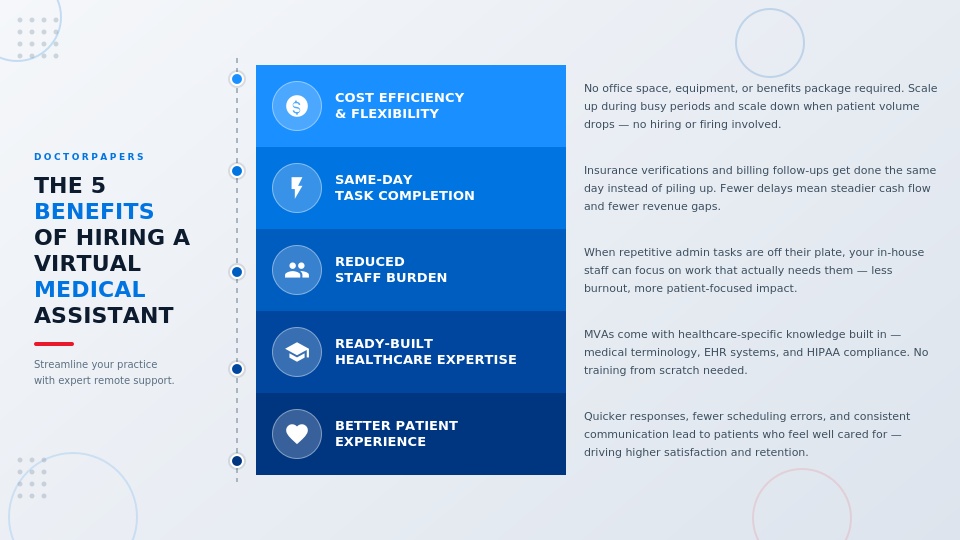
The benefits of hiring a virtual medical assistant go beyond just getting tasks off your plate. Because MVAs work remotely, you do not need to provide office space, equipment, or a full benefits package.
You pay for the hours worked, which means you can scale up or down based on what your practice actually needs.
Some of the key benefits include:
- Scale up during busy periods and scale down when patient volume drops. No hiring or firing involved.
- Tasks like insurance verification and billing follow-ups get done the same day instead of piling up.
- When repetitive admin tasks are off their plate, your staff can focus on work that actually needs them there.
- MVAs come with healthcare-specific knowledge already built in. You are not training someone from scratch.
- Quicker responses, fewer scheduling errors, and consistent communication all lead to patients who feel well taken care of.
Conclusion
The scope of Medical Virtual Assistant tasks available to practices today is wide, and it keeps growing. From handling insurance verifications and scribing patient encounters to tracking compliance deadlines and managing billing workflows, a skilled MVA touches nearly every part of how a practice runs.
If you are a practice owner trying to figure out where to start, look at where your team loses the most time or makes the most errors. Those are the tasks worth delegating first.
For practices looking for reliable, healthcare-trained virtual support,DoctorPapers connects medical teams with experienced MVAs who understand clinical workflows, compliance requirements, and the real day-to-day demands of running a practice. It is a practical starting point for any team ready to work smarter.
Frequently Asked Questions
1. What are the most common Medical Virtual Assistant tasks in a private practice?
The most common tasks include appointment scheduling, insurance verification, patient communication, EHR data entry, and billing support.
Most practices start with scheduling and front office communication, then expand into clinical and financial support over time.
2. What are the administrative tasks of a medical virtual assistant that can replace in house staff?
The administrative tasks of a medical virtual assistant, including call handling, scheduling, claim follow-up, and record management, can effectively replace or support the role of a full-time front office employee.
Many solo and small group practices use MVAs as their main administrative layer without keeping in-house reception staff.
3. Are medical virtual assistants HIPAA compliant?
Yes. Professional MVAs receive HIPAA training, use secure platforms, and sign confidentiality agreements before working with any patient data.
Always ask about compliance credentials and data security protocols before bringing any virtual staff on board.
4. What are the benefits of hiring a virtual medical assistant compared to in-house staff?
The benefits of hiring a virtual medical assistant include lower overhead costs, flexible hours, access to trained specialists without long hiring processes, and less pressure on your existing team.
MVAs do not need a workspace, equipment, or a benefits package, which makes them a cost-effective option for growing practices.
5. How quickly can a medical virtual assistant fit into an existing workflow?
Most MVAs are up and running within one to two weeks for basic tasks like scheduling and patient communication.
More involved responsibilities like scribing or billing support may take two to four weeks as they learn your specific processes, templates, and provider preferences.