

Claim denials are one of the most damaging and preventable problems in healthcare finance. The American Medical Association estimates claims processing inefficiencies cost between $21 billion and $210 billion per year, according to HFMA’s reporting of AMA data.
Understanding denials in medical billing is the first step toward reducing their frequency and protecting revenue.
This blog identifies the top 5 denials in medical billing, explains what causes each one, and provides clear strategies that billing teams can apply immediately to improve claim acceptance rates and support a healthier revenue cycle.
What Is Denial in Medical Billing?
Before examining the most common types, it is important to understand what denial in medical billing actually means.
A denial occurs when a payer, whether a commercial insurer, Medicare, or Medicaid, refuses to reimburse a submitted claim. This refusal may be partial or complete. The payer communicates the reason through a denial code on the Explanation of Benefits or Electronic Remittance Advice.
Denial vs. Rejection
Denials are often confused with rejections, but they are not the same. A rejection happens before a claim enters the payer’s adjudication system, typically due to a formatting or data error.
A denial happens after the payer has reviewed the claim and determined it does not qualify for payment under their guidelines.
Why Denials Matter Financially
The financial impact of unmanaged denials in medical billing is significant. According to the American Medical Association, approximately 65 percent of denied claims are never reworked or resubmitted, meaning that revenue is permanently lost.
For most practices, even a modest reduction in denial rates produces a measurable improvement in cash flow and accounts receivable performance.
The Top 5 Denials in Medical Billing
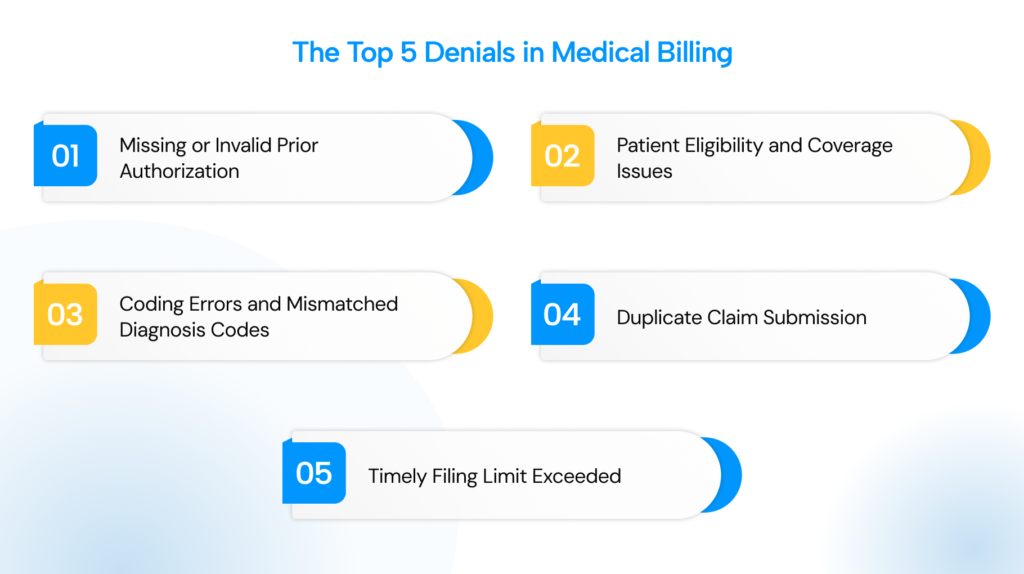
Understanding the top 5 denials in medical billing helps billing teams prioritize their prevention efforts where the financial impact is greatest.
Denial 1: Missing or Invalid Prior Authorization
What It Is:
Prior authorization denials occur when a payer requires advance approval for a procedure or service, and that approval was either not obtained, expired, or did not match the service billed. This is one of the most common and costly denials in medical billing.
Common Denial Codes:
CO-15 and CO-197 are frequently used by payers to indicate authorization-related denials.
Why It Happens:
Authorization requirements vary widely by payer and plan. Staff may not check authorization requirements before scheduling, or the authorization obtained may cover a different procedure code than what was ultimately billed.
According to the American Medical Association’s 2023 Prior Authorization Physician Survey published at ama-assn.org, 94 percent of physicians reported that prior authorization delays patient care, highlighting how widespread this issue has become.
Prevention Strategy:
Practices should implement a payer-specific authorization checklist and verify requirements at the time of scheduling.
Authorization tracking systems that flag expiration dates and mismatched procedure codes significantly reduce this denial category.
Denial 2: Patient Eligibility and Coverage Issues
What It Is:
Eligibility denials occur when a patient’s insurance is inactive, the service is not covered under their plan, or the claim is filed under incorrect insurance information. This is consistently among the top 5 denial codes in medical billing across all payer types.
Common Denial Codes:
- CO-27 indicates services not covered by the plan.
- CO-29 is used for expired coverage. C
- O-31 indicates the patient cannot be identified as the insured.
Why It Happens:
Insurance coverage changes frequently. Patients switch employers, lose coverage, or fail to update their information.
When eligibility is not verified at every visit, outdated information leads to denied claims that could have been avoided entirely.
Prevention Strategy:
Real-time eligibility verification at scheduling, pre-registration, and check-in eliminates the majority of these denials. CMS recommends verifying eligibility through the Medicare Beneficiary Identifier system before submitting any Medicare claim. The same discipline should be applied to all commercial payers.
Denial 3: Coding Errors and Mismatched Diagnosis Codes
What It Is:
Coding denials result from incorrect, outdated, or mismatched CPT, ICD-10, or HCPCS codes on a submitted claim. This is one of the most frequent healthcare billing denial categories and one of the most preventable.
Common Denial Codes:
- CO-4 indicates an incorrect procedure code.
- CO-11 signals a diagnosis code inconsistent with the procedure.
- CO-16 flags a claim that lacks the information needed for adjudication.
Why It Happens:
Coding errors often result from using outdated code sets, selecting codes that do not match the documented diagnosis, or failing to use the most specific code available.
Prevention Strategy:
Regular coding audits, updated code libraries, and continuous coder training are the most effective defenses. Claim scrubbing software that validates codes against payer rules before submission catches the majority of coding-related errors before they reach the payer.
Denial 4: Duplicate Claim Submission
What It Is:
A duplicate claim denial is issued when a payer receives more than one claim for the same service, same date of service, and same patient. While this may seem like a straightforward error, it is a common denial in medical billing that affects practices of all sizes.
Common Denial Codes:
CO-18 is the standard denial code for duplicate claims across most payers.
Why It Happens:
Duplicate submissions typically occur when a claim is resubmitted without confirming whether the original was already processed.
Staff following up on unpaid claims may submit a second claim, believing the first was lost, only to have both received and one denied as a duplicate. System errors and clearinghouse glitches can also generate duplicates without staff awareness.
Prevention Strategy:
Before resubmitting any claim, billing teams should check the claim status through the payer portal or clearinghouse.
Establishing a clear resubmission policy that requires status verification first eliminates most duplicate claim denials. Practice management systems with duplicate detection alerts provide an additional layer of protection.
Denial 5: Timely Filing Limit Exceeded
What It Is:
Every payer sets a deadline by which claims must be submitted following the date of service. When a claim is filed after that deadline, the payer issues a timely filing denial regardless of whether the service was medically necessary and properly documented.
Common Denial Codes:
CO-29 is the most frequently used denial code for late claim submissions.
Why It Happens:
Timely filing denials often result from delayed charge entry, slow documentation turnaround from providers, staff turnover, or simply a lack of tracking systems that flag approaching deadlines.
Filing limits vary significantly across payers. Medicare requires claims to be submitted within one year of the date of service. Many commercial payers have much shorter windows, some as narrow as 90 days.
Prevention Strategy:
A centralized deadline tracking system that monitors submission windows by payer is essential for high-volume practices.
Charge entry should be completed within 24 to 48 hours of service. Billing teams should conduct weekly aging reviews to identify claims approaching their filing deadlines before the window closes.
Bottom Line
Medical billing denials are costly, but the majority are preventable with the right processes in place. Authorization verification, real-time eligibility checks, accurate coding, duplicate claim controls, and timely submission tracking address the five denial categories that affect most practices most frequently.
Building structured workflows around each of these areas reduces denial rates, shortens accounts receivable days, and strengthens the financial stability of any healthcare practice.
Frequently Asked Questions
1. What is denial in medical billing?
A denial in medical billing occurs when a payer refuses to reimburse a submitted claim, either partially or in full.
The payer communicates the reason through a denial code on the Explanation of Benefits or Electronic Remittance Advice.
2. What are the most common denial codes in medical billing?
The most frequently used denial codes include CO-15 and CO-197 for authorization issues, CO-27 and CO-29 for eligibility and timely filing, CO-4 and CO-11 for coding errors, and CO-18 for duplicate claims.
Each code corresponds to a specific denial reason and guides the appropriate corrective action.
3. How can practices reduce denials in medical billing?
The most effective strategies include real-time eligibility verification, payer-specific authorization tracking, regular coding audits, claim scrubbing before submission, and a clear resubmission policy that requires claim status verification before filing a second claim.
4. What is the financial impact of denials in medical billing on a practice’s revenue cycle?
Unresolved denials reduce monthly collections, extend accounts receivable days, and create cash flow gaps that affect overall financial stability. The longer denials go unaddressed, the greater the cumulative revenue loss.
5. How does timely filing affect the revenue cycle?
Timely filing denials result in permanent revenue loss because claims submitted after the payer’s deadline cannot be appealed on the basis of clinical merit.
Medicare requires submission within one year of the date of service, while many commercial payers set shorter windows.