


Accurate medical coding is essential for proper billing, reimbursement, and clinical documentation. For medical coders and Medical billing professionals, understanding the correct ICD-10 code for Parkinson’s disease is a foundational requirement. This condition affects millions of people worldwide and carries specific coding rules that must be applied precisely.
This guide breaks down the current ICD-10 for Parkinson’s disease code classification, explains how dementia changes the coding approach, and highlights the documentation details that affect reimbursement outcomes.
What Is Parkinson’s Disease?
Parkinson’s disease is a progressive neurological disorder. It affects the central nervous system and primarily disrupts motor function.
The condition results from the loss of dopamine-producing neurons in a region of the brain called the substantia nigra. As dopamine levels decline, the brain loses its ability to coordinate smooth and controlled movement.
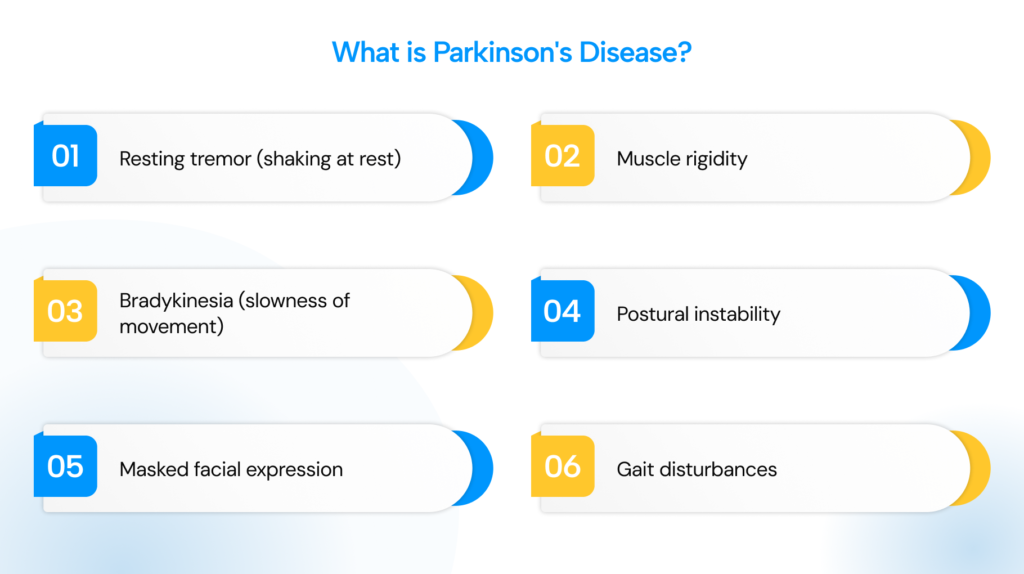
Common clinical features include:
- Resting tremor (shaking at rest)
- Muscle rigidity
- Bradykinesia (slowness of movement)
- Postural instability
- Masked facial expression
- Gait disturbances
Parkinson’s disease typically presents around age 60, though early-onset cases do occur. The condition is more prevalent in men than in women. There is currently no cure, though several treatment options help manage symptoms effectively.
Understanding the Parkinson’s Disease ICD-10-G20 Classification
The ICD-10 code for Parkinson’s disease falls under category G20 within the ICD-10-CM code set. This category is found in Chapter 6 of ICD-10-CM, which covers diseases of the nervous system, spanning codes G00 through G99.
The G20 parent code covers idiopathic Parkinsonism, primary Parkinsonism, paralysis agitans, and hemiparkinsonism. However, the G20 parent code alone is no longer sufficient for billing purposes. As of the 2024 code update, G20 was expanded into more specific subcategories. These subcategories remain in effect for 2026.
Current Billable Subcodes Under G20
The ICD-10 code for Parkinson’s disease requires the selection of one of the following specific subcodes:
- G20.A1 — Parkinson’s disease without dyskinesia, without mention of fluctuations
- G20.A2 — Parkinson’s disease without dyskinesia, with fluctuations
- G20.B1 — Parkinson’s disease with dyskinesia, without mention of fluctuations
- G20.B2 — Parkinson’s disease with dyskinesia, with fluctuations
- G20.C — Parkinsonism, unspecified
The distinction between dyskinesia and fluctuations is clinically important. Dyskinesia refers to involuntary movements often caused by long-term dopaminergic therapy.
Fluctuations refer to the wearing off of medication effects between doses. The physician’s documentation must clearly capture these details for the coder to select the correct subcode.
Using the parent Parkinson’s ICD-10 G20 code alone will result in a claim rejection because it is classified as a non-billable, non-specific code per the 2026 ICD-10-CM guidelines.
Coding Parkinson’s Disease With Dementia
Dementia is a recognized complication of Parkinson’s disease and significantly changes the coding approach. This distinction is one of the most important areas for coders to understand.
When a patient is diagnosed with Parkinson’s disease and also presents with dementia, a dual coding approach is required. The ICD-10 code for Parkinson’s with dementia is not a single, standalone code. Instead, coders must sequence two codes together.
How to Sequence the Codes
According to the coding conventions, when dementia is present alongside Parkinson’s disease, the appropriate G20 subcode must be listed first as the underlying etiology. The dementia is then reported using a code from the F02 category, which covers dementia in other diseases classified elsewhere.
The F02 codes are manifestation codes. They cannot be sequenced as the first listed diagnosis. They must always follow the underlying condition code, which in this case is the appropriate G20 subcode.
The ICD-10 code for Parkinson’s dementia will vary depending on the severity and behavioral features documented by the physician:
- F02.80 — Dementia in other diseases, unspecified severity, without behavioral disturbance
- F02.82 — Dementia with psychotic disturbance
- F02.83 — Dementia with mood disturbance
- F02.84 — Dementia with anxiety
- F02.A0 through F02.C4 — Cover mild, moderate, and severe dementia with various behavioral features
The ICD-10 code for Parkinson’s disease sequence in these cases is always the G20 subcode first, followed by the appropriate F02 manifestation code. Reversing this sequence is a coding error and will affect claim processing.
Documentation Requirements for ICD-10 Code for Parkinson’s Disease
Proper physician documentation is the foundation of accurate coding. Coders cannot infer clinical details that are not clearly stated in the medical record.
For Parkinson’s disease coding, the physician must document the following:
- Whether dyskinesia is present or absent
- Whether motor fluctuations are present
- The severity of dementia, if applicable
- Behavioral features associated with dementia, such as psychosis, mood changes, or anxiety
- Whether the condition is primary (idiopathic) or secondary in nature
Secondary Parkinsonism caused by medications or other conditions is not coded under G20. It falls under category G21. Coders must confirm from the documentation whether the physician has diagnosed primary Parkinson’s disease or a secondary cause before selecting a code.
When documentation is unclear, the appropriate step is to query the physician. Coding from incomplete records increases the risk of claim denial and audit liability.
Common Coding Mistakes to Avoid
Coding errors related to Parkinson’s disease are more common than many professionals realize. Each mistake below represents a distinct compliance risk that can affect reimbursement, trigger audits, or result in claim denials.
Using G20 as a Standalone Billable Code
This is the most frequent error seen in Parkinson’s disease medical billing. The G20 parent code is classified as a non-billable, non-specific code under the 2026 ICD-10 CM guidelines.
It cannot be submitted alone for reimbursement purposes. Coders must always select one of the specific subcodes, such as G20.A1, G20.A2, G20.B1, G20.B2, or G20.C, based on what the physician has documented.
Omitting the Dementia Manifestation Code
When the medical record documents both Parkinson’s disease and dementia, two codes are required. Many coders submit only the G20 subcode and leave the dementia unrepresented. This is a coding error.
The appropriate F02 manifestation code must always be added to reflect the type and severity of dementia present. Submitting an incomplete code set leads to inaccurate clinical representation and potential undercoding.
Reversing the Code Sequence
The etiology and manifestation convention requires the underlying condition to be sequenced first. In Parkinson’s disease with dementia, the G20 subcode must always come before the F02 code.
Reversing this order violates ICD-10-CM coding conventions. F02 codes are manifestation codes and are never permitted to be listed as the first or principal diagnosis.
Confusing Primary and Secondary Parkinsonism
Not all Parkinsonism is Parkinson’s disease. Drug-induced Parkinsonism, for example, is reported under G21.1, not under the G20 category. Vascular and other secondary causes also map to G21 subcodes.
Assigning a G20 subcode when the physician has documented a secondary cause is a clinical misrepresentation. Coders must read the physician’s diagnosis carefully before making any code selection.
Omitting Additional Codes for Related Manifestations
Parkinson’s disease can present alongside other reportable conditions. Fluency disorders, for instance, require code R47.82 when Parkinson’s disease is identified as the underlying cause.
Mild neurocognitive disorder related to Parkinson’s disease may require a code from the F06.7 series. Failing to capture these additional codes results in an incomplete picture of the patient’s condition and can affect care coordination and reimbursement accuracy.
Additional Codes That May Apply
The ICD Parkinson’s disease coding framework allows for supplementary codes when related conditions are clearly documented.
These include:
- F06.7 series — For mild neurocognitive disorder related to Parkinson’s disease
- R47.82 — Fluency disorder in conditions classified elsewhere, when Parkinson’s disease is the underlying cause
- F02 series — For dementia at various severity levels with or without behavioral features
Coders should always review the instructional notes attached to the G20 category in the official ICD-10 CM tabular list. These notes specify when additional codes are required and how to sequence them properly.
The PD ICD-10 coding conventions are governed by the etiology and manifestation rule. This rule requires that the underlying disease always be coded first, with manifestation codes following in sequence.
Final Word
Accurate coding for Parkinson’s disease requires the correct G20 subcode, proper sequencing when dementia is present, and clear physician documentation. G20 alone is not billable. When in doubt, query the physician and verify against the current ICD-10 CM guidelines.
Frequently Asked Questions
What is the correct Parkinson’s ICD-10 code for billing purposes?
G20 is not billable on its own. Coders must select a specific subcode, such as G20.A1, G20.A2, G20.B1, G20.B2, or G20.C, based on the physician’s documentation.
What is the coding sequence when dementia is also present?
The appropriate G20 subcode is listed first as the underlying condition. The corresponding F02 manifestation code follows. This sequence cannot be reversed.
Is coding different for drug-induced Parkinsonism?
Yes. Drug-induced Parkinsonism is reported under G21.1, not G20. G20 applies only to primary or idiopathic Parkinson’s disease.
Can a subcode be assigned without documentation of dyskinesia?
No. If dyskinesia or fluctuation status is not documented, the coder must query the physician before assigning a subcode.
What is the difference between G20 and G21?
G20 covers primary or idiopathic Parkinson’s disease. G21 covers secondary Parkinsonism, which includes drug-induced and other externally caused forms. The physician’s documented diagnosis determines which category applies.