


You hire a promising VA. By week three, you notice recurring issues: they struggle to navigate your claims system independently, their documentation doesn’t match your standards, and they’re asking the same questions about prior authorization you covered on day two. The problem isn’t the hire. It’s the training framework.
It’s that most practices don’t actually have a real training plan for medical virtual assistant training. They hand over a practice orientation document, show someone the EMR once, and assume the rest will click into place.
When you train a virtual medical assistant the right way, they become genuinely useful. They manage virtual medical assistant services that protect your revenue cycle. They reduce the denials that slip through because eligibility wasn’t verified correctly. They handle callbacks so your clinical staff can focus on patients. But that outcome requires a different approach than most practices take. This is how you actually do it.
What Needs to Happen Before They Start
Define the scope precisely. If your VA is handling callbacks, what types of calls? Are they managing patient questions about bills, or are they coordinating appointment changes, or both? What information can they share with a patient, and what goes to someone else? If they’re supporting onboarding a virtual assistant for clinic around eligibility, do they verify coverage before every appointment, or only for new patients, or only for certain insurance types?
This clarity directly determines your training approach. Someone verifying eligibility on 30 patients a day needs completely different training than someone who verifies eligibility on two patients a week. The depth is different. The edge cases they encounter are different.
Define success metrics before hiring. “Handle claims” is unmeasurable. “Research denial reasons, identify appealable denials within 30 days, and flag for follow-up” provides clear training targets and measurement points. Your VA needs these standards on day one.
The First Month: Foundation Over Speed
Week one, they learn your practice. Not the company’s mission statement, but the actual workflow. How does a patient enter your system? What happens between intake and billing? Where do things typically go wrong?
Walk them through a full patient cycle, start to finish. Let them shadow if they can, even for just half a day. They’re building context.
Week two and three are when you integrate virtual assistant into practice systems in real time. Don’t just give them EMR login credentials and tell them to watch a video. Work alongside them. Show them where eligibility information lives in your system.
Show them how a claim moves from pending to submitted. Show them what happens when a claim gets denied and how your team researches it. Show them the actual stuff they’ll do every day, not the theoretical version.
This is also when you teach HIPAA compliance not as a checkbox training, but as part of their actual work. They’ll be accessing protected health information constantly. They need to understand what that means.
What information can they discuss with patients? What gets escalated to a provider? What happens if they accidentally email something to the wrong person? Make it real, not a compliance video.
By week four, they should be doing actual work, but you’re watching closely. They’re handling callbacks while you listen in occasionally. They’re running eligibility verifications while you review what they documented. They’re pulling claims that need follow-up while you check their work daily. This isn’t micromanaging, but it’s where the real training happens. This is where you catch misunderstandings before they become habits.
EMR Training and System Fluency
Your VA needs to know your EMR the way your staff knows it. Not perfectly, but well enough to move around, find information, and understand what they’re looking at.
If you use Epic, they need to understand Epic. Athena, they need Athena. Dedicate a full week to system training, nothing else. Pair them with a clinical or billing staff member who uses the system daily. Have them observe, practice tasks, and ask questions in real time. Learning solidifies through connected work, not isolated training modules.
Beyond your EMR, what other systems touch their work. Insurance verification platforms. Patient portals. Your scheduling software. Billing and accounting systems. Any tool they’ll use needs intentional training.
And here’s what matters: don’t assume they’ll figure it out. They won’t. You’ll be answering the same questions three weeks from now because you didn’t block out training time upfront.
There’s also the question of what access they actually need. Some practices over-permission their VAs out of laziness. They get database access when they only need to run eligibility checks. Limit access to what the job requires. It’s better for compliance, and it keeps them focused on what matters.
Key Responsibilities That Separate Effective VAs from Struggling Ones
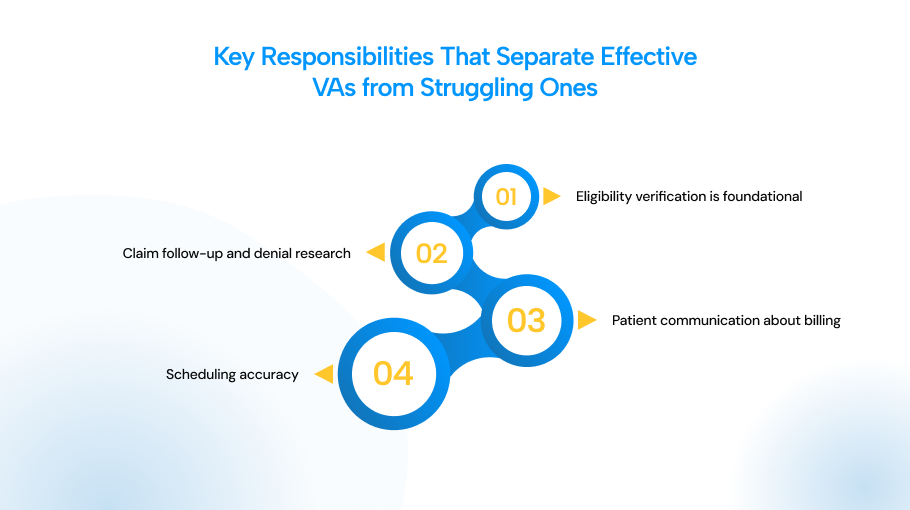
Some tasks matter more than others when it comes to your revenue cycle.
- Eligibility verification is foundational. If your VA misses coverage gaps or gets insurance details wrong at intake, everything downstream inherits that problem. A claim that’s submitted under the wrong insurance or to the wrong payer gets denied before it even hits the adjudication queue. Train this thoroughly. Let them verify 10 eligibility checks while you review each one. Point out what they missed. Have them try again. This is where repetition actually serves a purpose.
- Claim follow-up and denial research is where your VA directly impacts your revenue cycle. They need to understand denial codes well enough to categorize why a claim was denied. Not code it themselves, that’s your biller’s job, but understand whether it’s a coverage issue, a documentation issue, or a timing issue. That categorization informs whether something gets appealed, resubmitted, or escalated. Train them on your top 10 denial reasons. Show them real examples from your practice, not generic textbook examples.
- Patient communication about billing matters more than practices realize. When a VA talks to a patient about what they owe, their tone and accuracy either improve or damage your collections. They need clear guidelines on what they can explain (your bill is $200 because your insurance paid $X and your deductible is $Y) versus what they can’t (your insurance should have paid this; let me call them). Train them on your collection scripts. Let them do practice calls with your front desk staff before they take real patient calls.
- Scheduling accuracy seems simple until you realize a messed-up schedule cascades into billing problems. If they double-book a provider, that affects how many patients get seen and, eventually, revenue. If they schedule a patient with a specific insurance type in a slot blocked for a different plan, that causes issues. Train them on your scheduling rules. Show them the blocked time. Let them understand the why, not just the what.
Communication, Feedback, and Adjustment
Once your VA is past the first month, the work shifts, but training doesn’t stop.
Set up regular check-ins. Weekly for the first six weeks, then bi-weekly after that. These aren’t status meetings. They’re working sessions where you talk about what’s actually happening.
If they’re struggling with claim categorization, figure out why. Is it that they don’t understand the denial codes, or is it that they’re unsure when to escalate versus when to handle it independently? Get specific. Vague feedback doesn’t change behavior.
Create a practice manual as you go. When your VA learns how your payers handle prior authorization, write it down. When they figure out a faster workflow in your EMR, document it. This manual is insurance against turnover. Next time you hire, that person isn’t starting from zero. It also keeps standards consistent.
Build a channel where they can ask questions without feeling like they’re bothering someone. Slack, email, a shared doc, whatever works for your team. If they’re confused about something at 2 PM, they shouldn’t have to wait until tomorrow to ask. Fast clarification means faster independent work.
Healthcare Virtual Assistant Onboarding and Ongoing Development
By week 12, your VA should be working independently on most assigned tasks. But they’re still new to the practice. Things will come up that they haven’t seen before.
Track metrics that matter to your practice. If they’re handling eligibility, measure accuracy and turnaround time. If they’re managing callbacks, measure whether they’re capturing the right information or if callbacks are bouncing back to the team. Metrics aren’t punishment, they’re feedback. They tell both you and your VA whether the training is working.
Schedule a real review at the 90-day mark. How are they actually doing. What’s going well. What’s still fuzzy. Are they ready to take on more, or do they need deeper training in something specific. This conversation matters because it tells you whether your train virtual medical assistant investment is paying off or whether something needs to shift.
When things aren’t working, don’t just blame the hire. Sometimes the problem is that the role changed mid-stream. Sometimes they’re unclear on a specific workflow because your practice skipped training in that area.
Sometimes they’re doing the work the way their last employer did it, and your practice does it differently. Troubleshoot together. Most issues can be fixed with clarity and feedback.
Where Does This Connect to Your Revenue Cycle
A well-trained VA isn’t just completing administrative tasks. They’re protecting your medical billing services workflow.
They catch insurance changes before claims are submitted. They flag eligibility issues that would otherwise become denials. They manage the claim lifecycle in a way that speeds reimbursement. They handle patient communication about bills in a way that improves collections.
When your VA understands how their daily work connects to revenue cycle management, they work differently. They’re more careful about accuracy. They understand why timing matters. They ask smarter questions.
The practices that see real ROI from virtual medical assistant services are the ones that have trained their VAs to think about the bigger picture. That’s a training mindset shift, not a new skill. It starts early and continues throughout their tenure.
Conclusion
How to train a medical virtual assistant comes down to treating it as a real investment, not a box to check. You’re building someone who understands your practice’s specific workflows, respects your compliance standards, and can actually contribute to your financial health. The first 90 days set everything up.
Practices that invest in clear task definition, hands-on training, regular feedback, and ongoing support end up with VAs who move from struggling with basics to confidently managing patient communication, claim follow-up, and eligibility verification.
If you’re considering virtual medical assistant services through a staffing partner like DoctorPapers, insist on a training structure that goes deeper than generic onboarding. Your VA can only be as effective as the training framework you put in place.
Frequently Asked Questions
Q: How long before a medical virtual assistant is actually productive?
A: You’ll see meaningful output by week 8 or 10, depending on the role. Simple scheduling might be three months. If they’re managing complex claim issues and need to understand your payer relationships, plan for four to six months before they’re operating at the level you need.
Q: What’s the one thing practices get wrong most often with VA training?
A: Pushing them to independent work too fast. Most practices move into a hands-off mode by week four or five, before the VA has enough repetition to handle the edge cases and exceptions that come up every day. Stay in an oversight mode longer than feels necessary, and you’ll see fewer mistakes and faster actual productivity.
Q: Do we need HIPAA training, and is once enough?
A: Do it before they access any patient information, that’s non-negotiable. Annual refresher is standard, but honestly, many practices do it once and never revisit it. That’s a compliance gap. Quick quarterly touch-points work better.
Remind them of key rules: how to handle a potential breach, what they can share with patients, and confidentiality around conversations with providers. It doesn’t need to be long, just consistent.
Q: Can a virtual assistant handle billing or coding work?
A: Some can, depending on their background. A VA with medical billing experience might be able to research claims or help with denial appeals. Someone without that background shouldn’t be assigned coding work just because you’re short-staffed. Be realistic about what your hire can do, train them accordingly, and keep roles clear.
Q: How do you know if someone’s actually going to work out?
A: Watch how they respond to feedback in the first three weeks. Do they ask clarifying questions or make assumptions. Do they take notes or expect you to repeat things.
Do they seem curious about your practice’s workflow or just going through the motions. The best VAs are engaged from day one. If someone’s coasting, that’s usually a signal they’re not the right fit.