


Front desks across the country are stretched thinner than they were even two years ago. Prior authorization requests pile up faster than staff can clear them, insurance verification gets rushed between patient calls, and billing teams end up working nights just to keep denials from snowballing. Clinics that used to handle everything in-house are now looking outside their walls for help with medical billing services, staffing, and general medical practice support. That’s part of why demand for medical virtual assistant services usa wide has climbed so sharply, and why practice managers are asking a harder question now: which partner actually understands healthcare operations, not administrative work in general.
What’s Pushing Clinics Toward Virtual Support
The workforce numbers behind this shift are hard to ignore. According to HRSA’s Bureau of Health Workforce, the National Center for Health Workforce Analysis projects an overall shortage of 141,160 physicians by 2038, with 30 of 35 specialties modeled to fall short.
That gap doesn’t show up only in exam rooms. It shows up in front offices too, where fewer support staff are expected to cover more ground with the same number of hours in a day.
Practices feel this differently depending on size and specialty. A solo practitioner might notice it as a backlog of unreturned patient calls. A multi-provider group might see it in a slower claim turnaround. Either way, the pattern is the same: administrative capacity hasn’t kept pace with patient volume, and something has to give.
This is where medical virtual assistant services usa clinics can start to matter. Not as a stopgap, but as a structural fix to how the work actually gets distributed.
Why Clinics Land on DoctorPapers Specifically
DoctorPapers built its medical virtual assistant services around one idea: administrative support only works if the person doing it already understands medical billing, coding, and payer behavior.
General virtual assistants can format a spreadsheet or answer a generic email. They generally can’t tell the difference between a modifier error and a documentation gap, and that difference is exactly what determines whether a claim gets paid.
Every assistant is trained specifically for healthcare workflows, not onboarded as a generalist and pointed toward a manual. Practices connect with assistants who already know how to work inside 25-plus EHR systems, follow HIPAA protocols without needing reminders, and flag issues before they turn into denied claims.
That last part matters more than people tend to realize. A denial caught early costs a few minutes. A denial caught after resubmission deadlines pass can cost the practice weeks of delayed revenue.
There’s also the contract structure, which quietly shapes how much trust clinics put into a vendor. DoctorPapers doesn’t lock practices into long-term agreements, which means the relationship has to keep earning its place month over month instead of coasting on a signature.
Where the Support Actually Shows Up
The range of tasks a virtual assistant can absorb is wider than most practices expect going in. Here’s where DoctorPapers assistants typically plug in:
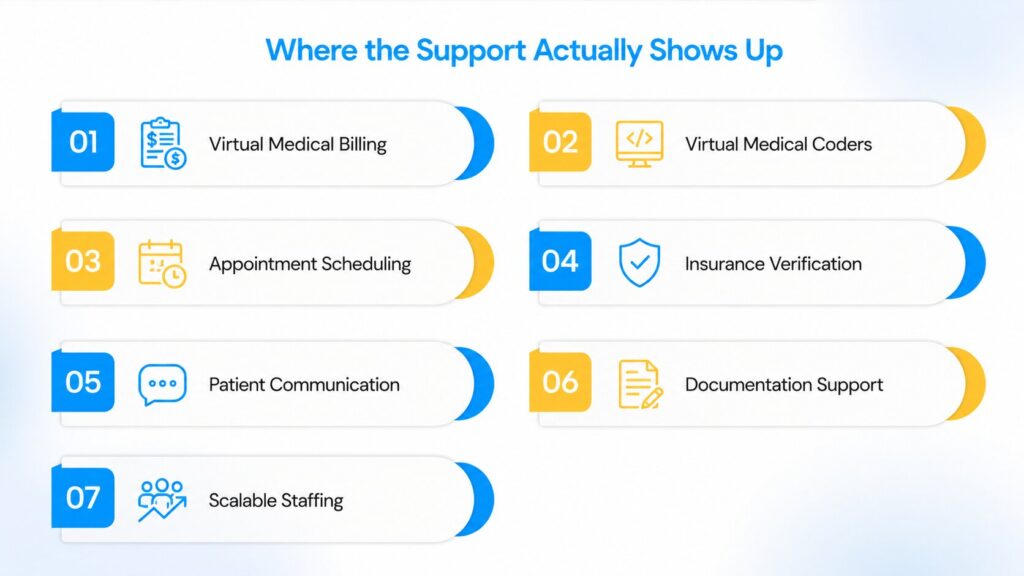
- Virtual Medical Billing: Assistants manage charge entry, claim submission, and payment posting on a consistent schedule, which keeps the revenue cycle moving instead of stalling between staff shifts.
- Virtual Medical Coders: Coding accuracy directly affects reimbursement speed, and a trained coder catches mismatches between documentation and billed codes before a payer ever sees the claim.
- Appointment Scheduling: Beyond booking slots, assistants manage cancellations, reminders, and rescheduling patterns that otherwise eat into a front desk’s day in small, constant interruptions.
- Insurance Verification: Coverage gets confirmed before the visit happens, not scrambled together while a patient waits at the counter.
- Patient Communication: Calls, messages, and follow-ups get handled with enough consistency that patients stop feeling like they’re chasing answers.
- Documentation Support: Charting and records stay organized in a way that holds up during audits, not just during a normal week.
- Scalable Staffing: A practice adding a provider or opening a second location can bring on more support without running a full hiring cycle from scratch.
Not every practice needs all seven at once. Some start with billing and coding, then expand into patient communication once the back office is stable. The order tends to matter less than the fact that each piece connects to the others.
In-house Staff vs. Generic Freelancers vs. DoctorPapers
| Factor | In-house staff | Generic freelance VA | DoctorPapers virtual assistant |
| Healthcare training | Varies by hire | Rarely healthcare-specific | Trained specifically in billing, coding, and payer workflows |
| HIPAA compliance | Requires ongoing internal management | Not guaranteed | Built into onboarding and daily process |
| EHR familiarity | Limited to what’s used locally | Often none | Compatible with 25-plus EHR systems |
| Cost structure | Salary, benefits, turnover risk | Lower cost, inconsistent quality | Predictable cost without long-term contracts |
| Scalability | Slow, tied to hiring cycles | Fast but unreliable | Fast and structured around practice growth |
What This Means for Day-to-Day Operations
The clearest sign that this kind of support is working isn’t a dramatic turnaround. It’s smaller and quieter than that. Claims go out within 24 to 48 hours instead of sitting in a queue.
Patients stop calling twice to get the same answer. A practice manager stops fielding billing questions during lunch because someone else already handled it that morning.
Growth is where the difference tends to show up most clearly, though. Adding a provider or expanding into a second location usually means a scramble to hire, train, and absorb new administrative volume all at once. With scalable virtual staffing already in place, that expansion becomes an adjustment instead of a crisis. It’s not a fixed formula, and results vary somewhat by specialty and payer mix, but the underlying pattern holds across most practice types.
Bringing it Back to the Practice
None of this works as a one-time fix. Medical virtual assistant services usa wide are becoming less of an add-on and more of a standard operating structure, especially as workforce pressure keeps building across the industry.
Clinics that treat administrative support as an afterthought tend to feel that gap first in denied claims and second in patient frustration.
DoctorPapers built its approach around closing that gap with people who already understand healthcare, not generalists learning it on the job. If your practice is weighing whether virtual support fits your workflow, it’s worth looking at what other providers offer around the country before deciding, and this comparison of leading medical virtual assistant companies is a reasonable place to start.
Frequently Asked Questions
1. What tasks can a medical virtual assistant actually take off my plate?
Billing, coding, scheduling, insurance verification, documentation, and patient communication are the core areas, and most practices start with whichever one is causing the most friction right now.
2. Is this secure enough for patient data?
Yes, and this tends to be the first thing practices ask about. DoctorPapers assistants work under HIPAA-compliant protocols with encrypted systems and role-based access, so patient information isn’t handled any less carefully than it would be in-house.
3. How is this different from just hiring an in-house biller?
An in-house hire comes with salary, benefits, training time, and turnover risk. A virtual assistant partner already arrives trained, and the practice isn’t stuck rebuilding that expertise every time someone leaves.
4. Can virtual assistants handle credentialing and payer-specific rules, or is that too specialized?
It’s specialized, but it’s also exactly the kind of work these assistants are trained for. Payer rules shift often enough that having someone who tracks those changes daily is more useful than most practices expect.
5. What if my practice already has some in-house staff handling part of this?
That’s common, and it doesn’t need to be an all-or-nothing decision. Many practices keep certain functions in-house and hand off the rest, adjusting the mix as the practice grows or as staff turnover happens.