


Medical practices of every size are under the same pressure: keep patients well served while keeping administrative overhead under control. A virtual receptionist for medical practice front-desk operations is one of the more effective ways to do both, a remote, technology-enabled service that handles patient calls, appointment scheduling, and routine front-office communication without adding a full in-house salary.
This guide covers what a virtual receptionist actually does, how the cost compares to hiring in-house, and how to choose and implement one for your practice.
What Is a Virtual Receptionist for a Medical Practice?
A virtual medical receptionist is a remote front-desk specialist who handles the same core tasks an in-office receptionist would: answering calls, scheduling and confirming appointments, managing prescription refill requests, and fielding routine patient questions, just without sitting at a desk in your building.
It’s worth distinguishing this from a broader medical virtual assistant. A virtual receptionist focuses specifically on front-desk and call-handling tasks, while a full medical virtual assistant can extend further into insurance verification, EHR data entry, and billing support. Many practices start with a virtual receptionist for phones and scheduling, then expand into broader virtual administrative assistant support as needs grow.
Key Benefits of a Virtual Receptionist
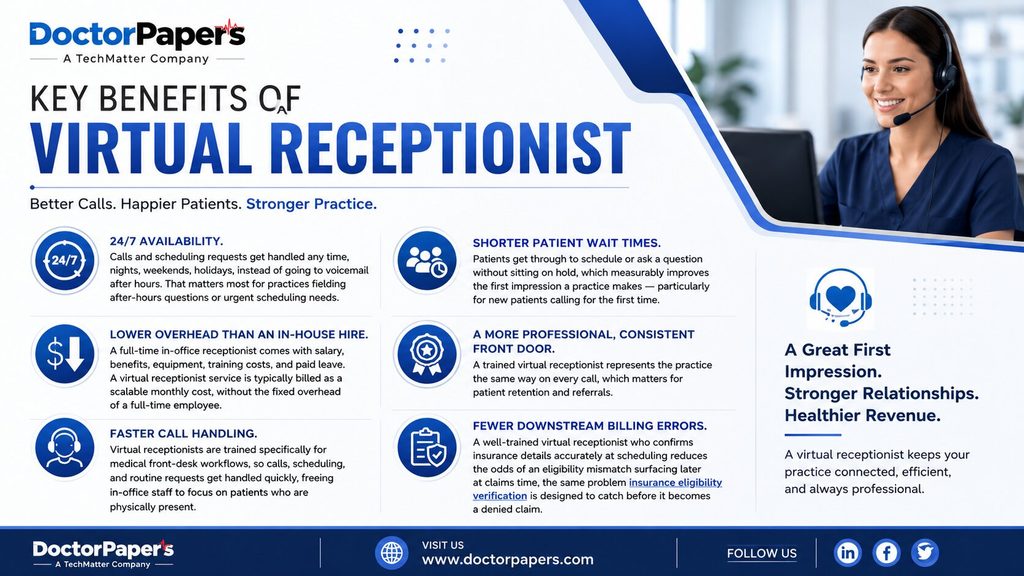
24/7 availability. Calls and scheduling requests get handled any time, nights, weekends, holidays, instead of going to voicemail after hours. That matters most for practices fielding after-hours questions or urgent scheduling needs.
Lower overhead than an in-house hire. A full-time in-office receptionist comes with salary, benefits, equipment, training costs, and paid leave. A virtual receptionist service is typically billed as a scalable monthly cost, without the fixed overhead of a full-time employee.
Faster call handling. Virtual receptionists are trained specifically for medical front-desk workflows, so calls, scheduling, and routine requests get handled quickly, freeing in-office staff to focus on patients who are physically present.
Shorter patient wait times. Patients get through to schedule or ask a question without sitting on hold, which measurably improves the first impression a practice makes — particularly for new patients calling for the first time.
A more professional, consistent front door. A trained virtual receptionist represents the practice the same way on every call, which matters for patient retention and referrals.
Fewer downstream billing errors. A well-trained virtual receptionist who confirms insurance details accurately at scheduling reduces the odds of an eligibility mismatch surfacing later at claims time, the same problem insurance eligibility verification is designed to catch before it becomes a denied claim.
Cost Comparison: Traditional vs. Virtual Receptionist
| Cost Factor | In-House Receptionist | Virtual Receptionist |
|---|---|---|
| Salary & benefits | Typically $35,000–$60,000+/year, depending on state and experience | Typically a few thousand dollars per year, scaled to call/task volume |
| Equipment | Desk, phone system, computer setup | Not applicable |
| Training | Ongoing onboarding and refresher training | Included in service |
| Sick days & PTO | Paid leave, coverage gaps during absence | Not applicable — coverage is continuous |
Exact in-house salary costs vary significantly by state and experience level; the U.S. Bureau of Labor Statistics’ Occupational Employment and Wage Statistics publishes current wage benchmarks for medical secretaries and administrative assistants by state if you want to compare against your local market before deciding.
Virtual Receptionist vs. In-House: Which Fits Your Practice?
- Solo or small practices often see the clearest ROI from a virtual receptionist, since a full-time in-house hire may not be justified by call volume alone.
- Growing or multi-location practices benefit from the scalability, adding coverage doesn’t require hiring and training another employee per location.
- Practices with heavy after-hours call volume (urgent care, specialty practices with pre-procedure questions) benefit disproportionately from 24/7 coverage that in-house staff can’t realistically provide.
- Practices with a strong existing front-desk team may only need a virtual receptionist for overflow, after-hours, or backup coverage rather than full replacement.
How to Choose and Implement a Virtual Receptionist Service
- Vet the provider’s healthcare experience. Ask specifically about HIPAA training and experience with medical scheduling workflows, a generalist call-answering service isn’t the same as a trained medical virtual receptionist. Confirm the vendor can document compliance consistent with the HHS HIPAA Security Rule and is willing to sign a Business Associate Agreement (BAA).
- Check EHR/practice management compatibility. The virtual receptionist should be able to work directly within your existing scheduling system rather than through a separate, disconnected tool.
- Build practice-specific scripts and guidelines. Work with the provider to document how your practice wants calls handled — hold procedures, urgent-call escalation, and what information can and can’t be shared over the phone.
- Start with a defined scope and expand. Many practices begin with after-hours or overflow coverage before moving to full front-desk replacement, so performance can be evaluated before a bigger commitment.
The Role of a Medical Receptionist Is Changing, Not Disappearing
A medical receptionist’s core responsibilities, scheduling, patient communication, record coordination, haven’t gone away; what’s changed is where and how those tasks get done. Online booking systems, secure messaging, and remote staffing models mean the role increasingly blends traditional front-desk skills with digital tools, whether the person filling it sits in your waiting room or works remotely as part of a virtual team.
FAQ
Is a virtual receptionist the same as an answering service?
No. A general answering service typically takes messages. A medical virtual receptionist actively schedules and manages appointments, handles routine patient requests, and is trained specifically in healthcare front-desk workflows.
Is a virtual receptionist HIPAA compliant?
It can be, but that depends entirely on the vendor. Confirm HIPAA training, request a signed Business Associate Agreement, and ask how patient information is transmitted and stored before signing on.
Can a virtual receptionist fully replace an in-house front desk?
For many small and solo practices, yes. Larger or multi-provider practices often use a hybrid model, virtual coverage for after-hours, overflow, or backup, with in-house staff handling in-person check-in.
Does a virtual receptionist help reduce billing errors?
Indirectly, yes. Accurate scheduling and insurance information collected at the point of contact reduces downstream eligibility mismatches that would otherwise surface as denied claims.
Looking to reduce front-desk overhead without sacrificing patient experience? See how DoctorPapers’ virtual assistant services support scheduling, calls, and administrative tasks for practices of every size