


The medical billing process is the sequence of steps a provider follows to turn a patient visit into paid revenue: registering the patient, verifying insurance, coding the service, submitting a claim, and following it until the payer and patient have paid in full. Done well, most claims are paid on the first submission. Done poorly, they bounce back as denials and sit in accounts receivable.
This guide walks through each step in order, shows where claims most often fail, and explains what changes for California practices in 2026.
What Are the Steps in the Medical Billing Process?
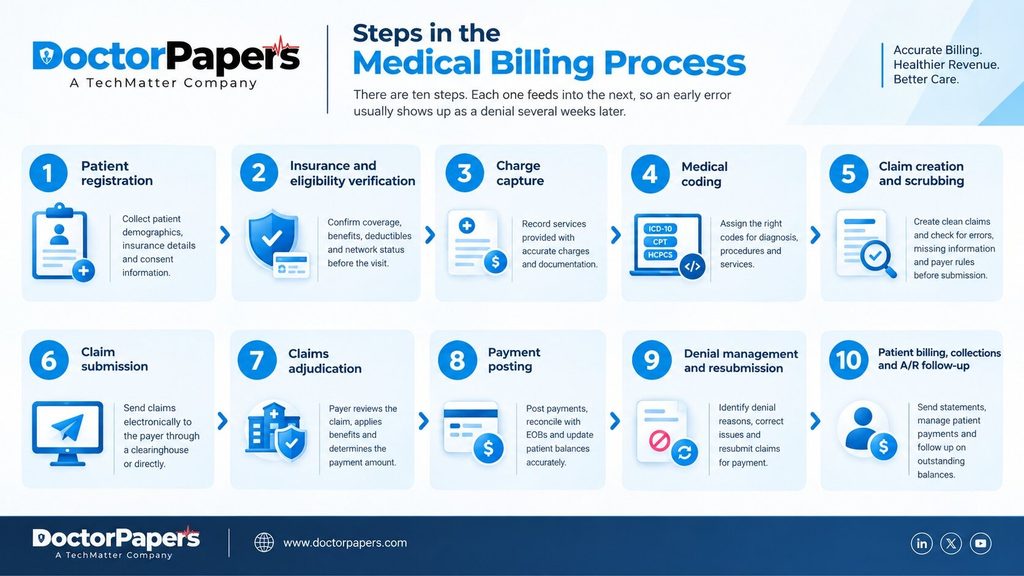
The medical billing process has ten steps. Each one feeds into the next, so an early error usually shows up as a denial several weeks later.
- Patient registration
- Insurance and eligibility verification
- Charge capture
- Medical coding
- Claim creation and scrubbing
- Claim submission
- Claims adjudication
- Payment posting
- Denial management and resubmission
- Patient billing, collections and A/R follow-up
Together, these steps make up the billing core of the wider revenue cycle management process, which also includes scheduling, authorizations, and credentialing.
Step 1: Patient Registration
Billing starts before the patient is seen. Front-desk staff collect demographics, insurance details, a photo of the insurance card and ID, and signed consent and financial responsibility forms.
Registration errors are small but costly. A misspelled name, a transposed member ID or a wrong date of birth is enough for a payer to reject the claim. Collecting information through a patient portal before the visit, rather than on a clipboard at check-in, removes most transcription mistakes.
Step 2: Insurance and Eligibility Verification
Before the visit, confirm that coverage is active, which plan the patient is on, the copay, deductible, and coinsurance, and whether the service needs prior authorization.
Plan type changes the rules. An HMO usually requires a referral and an in-network provider, while a PPO allows out-of-network care at a higher cost to the patient. Knowing how HMO, PPO, POS and EPO plans differ lets your team check the right requirements at the right time.
Eligibility problems are a leading cause of preventable denials. Our breakdown of common errors that prevent clean claims shows how often coverage and coding mistakes sit behind rejected submissions.
Step 3: Charge Capture
Charge capture is the process of recording every billable service, supply, and procedure from the encounter. Missed charges are lost revenue that is almost never recovered because the claim never reflects the work actually performed.
Reliable charge capture needs a single source of truth. Most practices rely on the EHR or practice management system to push charges from the clinical note, then reconcile the day’s appointments against the day’s charges.
Step 4: Medical Coding
Coders translate the clinical documentation into standardized codes: ICD-10-CM for diagnoses, CPT and HCPCS for procedures and services, and modifiers where the service needs additional context.
The code set must match the documentation. If a note does not support the level of service billed, the claim is vulnerable to denial or audit. Coding also changes every year, so certified coders and regular internal audits matter more than the software alone.
Step 5: Claim Creation and Scrubbing
A claim pulls together patient data, provider data, diagnosis codes, procedure codes and charges. Professional services are billed on the CMS-1500 form (or its electronic equivalent), and facility services are billed on the UB-04.
Before a claim leaves your system, claim scrubbing software checks it against payer rules and common edits. It catches missing fields, invalid code combinations, and mismatched diagnosis-and-procedure pairs. Fixing a claim at this stage takes minutes. Fixing it after a denial can take weeks.
Step 6: Claim Submission
Claims are submitted electronically, usually through a clearinghouse that routes them to the correct payer and returns acceptance or rejection reports within a day or so.
Pay attention to rejections versus denials. A rejection means the claim failed basic formatting or data checks and never entered the payer’s adjudication system, so you can correct it and resend it right away. A denial means the payer reviewed it and refused payment.
Every payer also sets its own timely filing limit. A claim submitted after that deadline is typically denied with little chance of appeal, so submit it within days of the visit.
Step 7: Claims Adjudication
Adjudication is the payer’s review of the claim. The payer checks eligibility, medical necessity, coding accuracy, authorization, and benefit limits, then decides to pay in full, pay in part, or deny.
The result arrives as an explanation of benefits to the patient and an electronic remittance advice to the provider. The remittance explains how the payment was calculated, including contractual adjustments and the patient’s share.
Step 8: Payment Posting
Payment posting records insurer and patient payments against the correct claims and applies adjustments. Accurate posting does two things: it tells you which balances remain, and it exposes underpayments.
Compare each payment to the contracted rate. Payers sometimes pay less than the agreed amount, and those shortfalls are easy to miss when posting is done in bulk or without the fee schedule at hand.
Step 9: Denial Management and Resubmission
When a claim is denied, the work is to find the root cause, correct it and resubmit or appeal within the payer’s deadline. Common causes include missing documentation, coding errors, eligibility problems, and lack of authorization.
The most useful habit is categorizing every denial by reason. After a few months, patterns appear, such as one payer repeatedly denying a specific code or one front-desk workflow producing the same eligibility error. A structured approach to denial management in healthcare turns those patterns into process fixes instead of repeated rework. Even a single payer code can point to a fixable workflow gap, as with the eligibility-related denial codes that follow from incomplete coverage checks.
Practices that lack the staff to work appeals on time often hand this step to a team that provides dedicated denial management services, because appeal windows are short and unworked denials become write-offs.
Step 10: Patient Billing, Collections and A/R Follow-Up
After insurance pays, the remaining balance moves to the patient. Send clear statements with itemized charges, offer online payment, and set up payment plans for larger balances. Patients who understand what they owe and why pay faster.
Meanwhile, unpaid insurance claims age in accounts receivable. Anything past 30 days needs a status check with the payer, and anything past 90 days needs escalation. Consistent A/R follow-up keeps older claims from becoming uncollectible, and practices that want help recovering aged balances can bring in accounts receivable services to work the backlog.
Where Do Claims Break Down? A Quick Reference
| Step | Most common failure | Practical prevention |
| Registration | Wrong name, ID, or date of birth | Pre-visit portal intake, insurance card scan |
| Eligibility | Inactive or incorrect coverage | Verify 24 to 48 hours before the visit |
| Charge capture | Missed procedures or supplies | Daily reconciliation of schedule vs. charges |
| Coding | Codes not supported by the note | Certified coders, routine coding audits |
| Submission | Late filing, rejected format | Submit within days, monitor clearinghouse reports |
| Adjudication | Missing authorization or documentation | Confirm prior auth before the visit |
| Denials | Appeals filed after the deadline | Track appeal windows by payer |
| A/R | Aging balances ignored | Weekly aging review by payer and bucket |
What Changes for California Providers in 2026?
California providers are affected by a state rule that changed payer payment timelines. Based on the California legislature’s bill text and a Department of Managed Health Care provider bulletin, AB 3275 took effect on January 1, 2026. It requires covered health plans and insurers, including HMOs and Medi-Cal managed care plans, to pay, contest, or deny a complete claim within 30 calendar days. The prior standard counted working days.
For billing teams, this makes clean, complete first submissions more valuable and makes it easier to spot slow payers. Confirm how the rule applies to each payer, since plan type and product line affect which standard governs.
Should You Handle Billing In-House or Outsource It?
The right answer depends on volume, staffing, and denial costs. In-house billing gives you direct control and works well when you have trained billers, enough claim volume to justify the software, and time to keep up with payer rule changes. It struggles when one person leaves, when coding rules change, or when denials pile up.
Outsourcing moves the work to a team that handles it daily. DoctorPapers, a TechMatter company headquartered in Glendale, California, provides outsourced medical billing services for practices, clinics, and hospitals, supported by 200+ billing specialists, 300+ healthcare providers served, and 25+ EHR integrations.
Two related options are worth knowing about. Providers who are new to a payer network need credentialing completed before claims can be paid, so delays there directly delay revenue. And practices that want a middle path, keeping control while adding capacity, can use virtual medical billing assistants to cover charge entry, claim follow-up, and payment posting. If you are weighing that route, this comparison of a virtual assistant versus in-house staff for claims lays out the trade-offs by cost per claim, denial rate, and days in A/R.
Which Metrics Show Whether Your Billing Process Works?
Track a small set of numbers every month rather than a long dashboard.
- First-pass acceptance rate: the share of claims accepted on the first submission.
- Denial rate: the share of claims denied, broken down by payer and reason.
- Days in A/R: the average time it takes to collect payment after a service.
- Net collection rate: payments collected as a share of what you were contractually owed.
- Aged A/R over 90 days: the portion of receivables at the highest risk of write-off.
Benchmarks vary by specialty and payer mix, so compare your trend over time before comparing it to industry averages.
Frequently Asked Questions
What is the medical billing process?
It is the end-to-end workflow that converts a patient encounter into payment: registration, eligibility verification, charge capture, coding, claim submission, adjudication, payment posting, denial handling, and collections.
How long does the medical billing process take?
It varies by payer. Electronic claims are often adjudicated within a few weeks, but denials, appeals, and patient balances can extend the cycle by months. In California, AB 3275 sets a 30-calendar-day standard for covered plans to act on a complete claim.
What is the difference between medical billing and medical coding?
Coding translates documentation into standardized codes. Billing uses those codes to build claims, submit them, and collect payment. Coding is one step inside the billing process.
What is a clean claim?
A clean claim is complete, accurate, and free of errors that would prevent a payer from processing it on first submission.
Why do medical claims get denied?
The most common causes are eligibility problems, coding errors, missing documentation, lack of prior authorization, and late filing.
What is the difference between a rejected and a denied claim?
A rejected claim failed formatting or data checks before reaching adjudication and can be corrected and resubmitted. A denied claim was reviewed and refused, and usually needs an appeal or a corrected claim within a deadline.
Is it better to outsource medical billing?
It can be, particularly for practices with rising denial rates, staffing gaps or growing volume. The decision should rest on cost per claim, denial rate and days in A/R, not on convenience alone.
Key Takeaways
- The medical billing process has ten steps, and errors in the first four are the most common source of later denials.
- Verify eligibility and authorization before the visit, not after the claim is denied.
- Scrub claims before submission and file within payer timely filing limits.
- Categorize every denial by cause so that fixes happen at the source.
- Review aging A/R weekly and escalate anything past 90 days.
- California practices should confirm how AB 3275’s 30 calendar day standard applies to each payer.
Next Step
If your denial rate or A/R days are higher than you want, a billing review will show where claims are breaking down. Contact DoctorPapers in Glendale, California at info@doctorpapers.com or +1 (412) 684-3034 to talk through your current workflow.