

Medical claims management is one of the most demanding responsibilities in any healthcare practice. Errors, delays, and missed follow-ups can cost practices thousands in lost or delayed reimbursements.
As administrative pressure grows, many providers are asking a straightforward question: Is a medical virtual assistant for medical claims more efficient than keeping the work in-house? This blog breaks down both options across the factors that matter most, including cost, accuracy, scalability, and workflow, so you can make an informed decision for your practice.
Understanding the Medical Claims Process
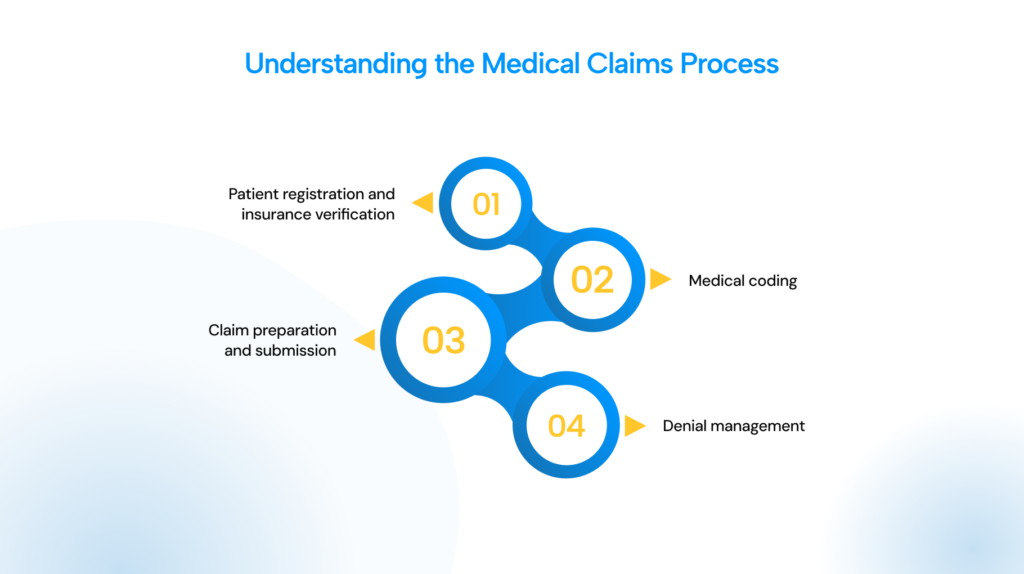
Before comparing staffing models, it helps to understand what the claims process actually involves. Medical claims management is not a single task. It is a chain of dependent steps, each one affecting the next. A delay or error at any stage can hold up reimbursement for weeks or trigger a denial that requires additional time and effort to resolve.
The core steps of the medical claims process include:
- Patient registration and insurance verification – Confirming coverage, eligibility, and authorization requirements before services are rendered
- Medical coding – Translating diagnoses and procedures into standardized ICD-10 and CPT codes that payers recognize
- Charge capture – Ensuring all billable services from a patient encounter are accurately recorded before claim submission
- Claim preparation and submission – Assembling a clean claim that meets payer-specific formatting and documentation requirements
- Claim tracking and status monitoring – Following submitted claims to confirm receipt and flag any that are delayed or unacknowledged
- Denial management – Reviewing rejected claims, identifying root causes, and submitting corrected or appeal claims within payer deadlines
- Payment posting and reconciliation – Recording received payments and reconciling them against expected reimbursements
- Patient billing and follow-up – Collecting any remaining patient balances after insurance has processed its portion
Each of these steps requires accuracy, speed, and familiarity with payer rules. When any step is handled inconsistently, the financial impact compounds quickly across the revenue cycle.
What Is a Medical Virtual Assistant for Medical Claims?
A medical virtual assistant for medical claims is a remote professional trained in healthcare billing processes. They work within secure systems to manage insurance verification, submit claims, track payments, and follow up on denials.
Unlike general administrative assistants, these professionals are trained specifically in payer guidelines, claim scrubbing practices, and reimbursement workflows. Many operate as part of structured remote billing teams with defined quality control measures.
For practices handling increasing claim volumes, a medical claims management virtual assistant can function as an extension of the revenue cycle team without the overhead of full-time in-house staff.
How Virtual Assistants Improve Medical Billing Efficiency
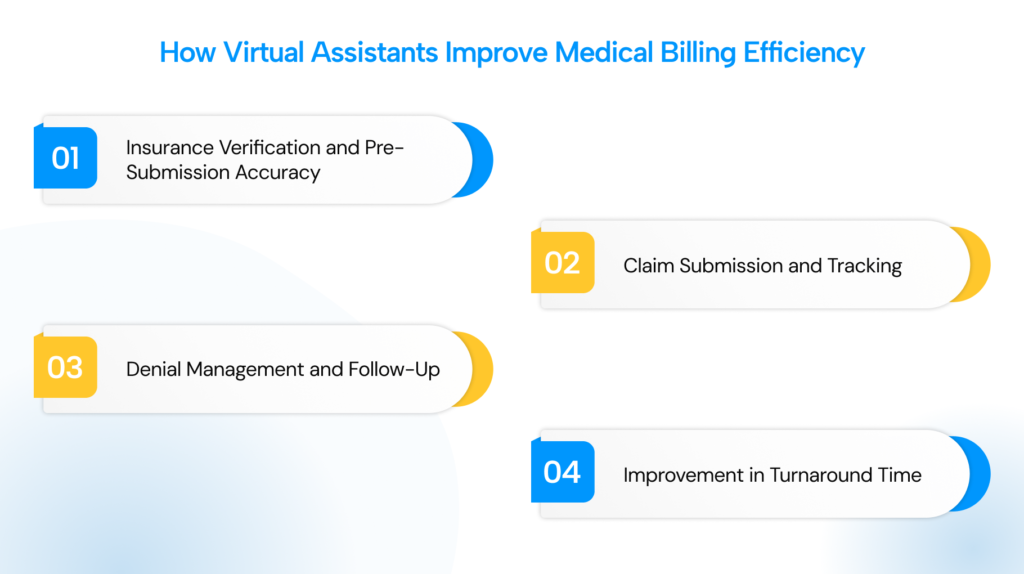
Efficiency in billing is measured by clean claim rate, turnaround time, and denial reduction. Virtual assistants improve these metrics in several practical ways.
Insurance Verification and Pre-Submission Accuracy
Before a claim is submitted, eligibility must be confirmed. Virtual assistants handle real-time insurance verification, checking coverage details, policy limits, and authorization requirements before a patient visit or service is billed. This front-end accuracy prevents a significant number of downstream rejections.
Claim Submission and Tracking
Once services are documented, virtual assistants prepare and submit claims in compliance with payer-specific guidelines. They monitor submission status in real-time and flag any claims that stall or receive no response within expected timeframes. This continuous tracking means nothing falls through the cracks.
Denial Management and Follow-Up
Denied claims require fast, targeted responses. A medical claims management virtual assistant reviews denial reasons, prepares corrected or appeal submissions, and resubmits within payer deadlines. This reduces write-offs and keeps accounts receivable moving.
Improvement in Turnaround Time
One of the clearest advantages of how virtual assistants improve medical billing efficiency is speed. Because virtual assistants work within structured workflows, they can process higher claim volumes without the slowdowns that come from staff absences, training gaps, or competing office priorities. Reimbursements arrive faster, and aging receivables shrink.
In-House Billing Staff: Strengths and Limitations
In-house teams have traditionally handled medical claims processing. They offer direct accessibility and internal coordination with clinical staff.
Strengths of In-House Teams
- Immediate physical presence in the office
- Direct communication with providers
- Familiarity with internal workflows
However, efficiency challenges often arise due to workload fluctuations, staffing gaps, and operational costs.
Common Limitations
In-house teams may struggle with:
- High administrative overhead
- Limited scalability during peak volumes
- Employee turnover
- Training costs for evolving payer rules
- Inconsistent denial follow-up due to competing responsibilities
When staff are overloaded, claim accuracy may decline, increasing rejection rates.
In-House Vs Virtual Assistant in Medical Billing: A Direct Comparison
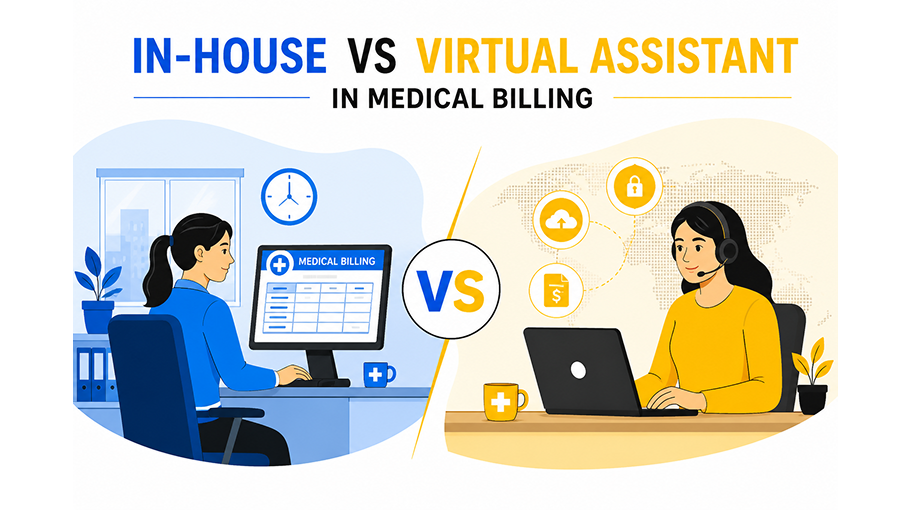
Understanding the in-house vs virtual assistant medical billing dynamic requires looking at the numbers and the day-to-day reality of managing a billing team internally. In-house billing staff brings familiarity with the practice environment, but they also come with significant overhead.
Salaries, benefits, office space, software licenses, and ongoing training represent fixed costs regardless of claim volume. When staff turn over, which is a frequent occurrence in billing roles, practices face recruiting costs and a productivity gap that can last months.
A medical virtual assistant for medical claims, by contrast, operates as a scalable resource. You pay for what you need, scale up during high-volume periods, and avoid the overhead tied to full-time headcount. The table below shows how the two models compare across the factors that matter most to practice performance.
| Factor | In-House Billing Staff | Medical Virtual Assistant |
| Cost | Fixed salaries, benefits, office space, and software averaging $45,000–$65,000 per biller annually | Typically 30–50% lower with no benefits, no office overhead, and flexible pricing |
| Accuracy | Depends on individual experience and training consistency | Follows standardized, audited workflows that reduce human error across every claim |
| Scalability | Scaling requires weeks or months of recruiting and onboarding | Scales immediately with practice growth or seasonal demand |
| Turnaround Time | Often slowed by competing office priorities and staff absences | Processes and tracks claims continuously without front-office interruptions |
| Workflow Efficiency | Vulnerable to staff turnover, knowledge gaps, and limited bandwidth | Integrates with major EHR and billing platforms for consistent, uninterrupted output |
| Denial Management | Follow-up speed depends on staff availability and workload | Dedicated follow-up on every denied claim within payer deadlines |
| Training & Compliance | Ongoing training costs fall on the practice | Virtual assistants arrive pre-trained in HIPAA compliance and payer-specific rules |
Which Model Is More Efficient?
Efficiency depends on measurable outcomes: denial rates, cost per claim, and days in accounts receivable.
Practices that rely solely on in-house teams may experience higher fixed costs and slower scaling during growth phases. On the other hand, a structured medical claims management virtual assistant system offers flexibility, specialized expertise, and workflow consistency.
For growing practices or multi-provider groups, remote support often delivers stronger operational performance while maintaining compliance with healthcare payer guidelines.
That said, some organizations choose a hybrid approach, combining internal oversight with virtual claim processing for maximum control and efficiency.
When Should Practices Consider a Virtual Assistant?
A shift toward virtual claims management may be appropriate when:
- Claim denial rates are increasing
- Administrative costs are rising
- Staff are overwhelmed with billing tasks
- Accounts receivable days are extending
- Growth plans require scalable billing support
If these issues persist, evaluating how virtual assistants improve medical billing efficiency becomes a strategic step rather than an optional upgrade.
Conclusion
Efficient claims management is essential for stable revenue and long-term growth. While in-house staff offers familiarity and direct communication, they often come with higher fixed costs and scalability limits.
A medical virtual assistant for medical claims provides flexibility, specialized expertise, and faster turnaround times. By reducing administrative workload, improving claim accuracy, and strengthening denial follow-up, virtual assistants help practices accelerate reimbursements and maintain financial stability.
For healthcare providers focused on efficiency and revenue optimization, the decision is no longer about replacing staff-it is about choosing the model that delivers measurable results in today’s demanding reimbursement environment.
Frequently Asked Questions
1. What does a medical virtual assistant for medical claims handle?
They manage insurance verification, claim submission, tracking, denial follow-ups, and payment posting while following payer guidelines and compliance standards.
2. Is a virtual assistant secure for healthcare billing?
Yes, when properly managed. Reputable providers use secure systems, HIPAA-compliant workflows, and controlled data access to protect patient information.
3. How does a virtual assistant reduce claim denials?
By verifying eligibility, reviewing documentation carefully, applying correct coding practices, and following structured submission processes before claims reach payers.
4. Is in-house billing more accurate than virtual billing?
Accuracy depends on expertise and workflow structure. Dedicated billing-focused virtual assistants often achieve high consistency because they concentrate exclusively on claims management.
5. Can practices combine in-house staff and virtual assistants?
Yes. Many organizations use a hybrid model where internal teams oversee operations while virtual assistants handle daily claim processing tasks.