

Influenza cases increase every year during the peak respiratory season. Globally, the World Health Organization reports that seasonal influenza leads to about 3 to 5 million severe cases annually, many involving serious respiratory manifestations.
This means that medical practices should learn how to accurately code for this disease due to the huge number of patients suffering from it. Otherwise, they may lose reimbursements, face compliance issues, and incur audit risks.
If you are a healthcare practice that is facing claim denials due to incorrect coding of the Influenza A ICD-10 Code J09.X2, this guide can serve as a comprehensive roadmap for you. It covers clinical documentation, coding rules, billing challenges, RCM strategies, and best practices related to this code.
Influenza A ICD-10 Code J09.X2: What You Need to Know
Code Definition
Influenza A ICD-10 Code J09.X2 refers to influenza due to an identified novel influenza A virus with other respiratory manifestations. It applies only when the strain is confirmed, and respiratory complications are present.
The term “novel” indicates a new strain that differs from common seasonal influenza patterns. Respiratory manifestations may include
- Pneumonia
- Acute bronchitis
- Other lower respiratory involvement directly linked to the infection
Clinical Scope
This code does not apply to routine seasonal flu. It specifically addresses confirmed novel influenza A strains associated with respiratory involvement.
Official Classification Authority
The Centers for Disease Control and Prevention maintains and annually updates the ICD-10-CM system to clarify terminology and reporting expectations. We recommend your coding team review updates before the influenza season to ensure compliance and avoid outdated interpretations.
Public Health Reporting Context
Accurate documentation becomes even more vital during outbreaks. Federal reimbursement policies during public health emergencies may align with guidance from the Centers for Medicare & Medicaid Services.
Clinical Documentation Requirements
Medical practices need to clearly and thoroughly document J09.X2 to justify its use, as incomplete or vague records increase denial risk and audit exposure. To support Influenza A ICD-10 Code J09.X2, healthcare documentation should include:
Confirmed Viral Identification
Providers must explicitly document that influenza A is confirmed and identified as a novel strain, providing evidence such as lab results or other diagnostic evidence. General statements like “flu positive” without specifying the strain are insufficient.
Detailed Respiratory Manifestations
The documentation should describe respiratory complications with specificity. For instance, viral pneumonia must be explicitly stated and connected to the influenza diagnosis. Symptom-only documentation, such as cough or congestion, does not justify J09.X2, leaving claims vulnerable to rejection during review.
Diagnostic Linkage in Provider Assessment
Physicians should explicitly list novel influenza A infection with its respiratory manifestation and emphasize that they are clearly linked in their assessment to avoid claim denials. Proper linkage enhances clarity for coders and payers, ensuring documentation supports medical necessity.
Laboratory Record Maintenance
Healthcare providers should make the laboratory evidence easily accessible as well as properly store it for audits. Institutions like Harvard Medical School emphasize accurate infectious disease documentation because organized lab results allow quick responses to payer inquiries and make it easy to defend claims.
Coding Guidelines for ICD-10 Code J09.X2
Accurate coding is critical for reimbursement and compliance. J09.X2 requires careful adherence to documentation and sequencing rules.
Use Only When Criteria Are Fully Met
Assign J09.X2 only when the influenza strain is confirmed as novel and accompanied by respiratory complications. Misclassification, such as coding seasonal influenza as novel, can lead to denials or audits. Compliance with coding rules protects revenue and ensures claim acceptance.
Follow Accurate Diagnosis Sequencing
Influenza should be coded as the primary diagnosis if it is the main reason for the visit. Secondary codes can capture additional complications. Proper sequencing ensures accurate claim submission and avoids confusion during payer review.
Avoid Symptom-Based Coding
Symptoms alone, like fever or fatigue, cannot justify J09.X2. Only a confirmed diagnosis with supporting documentation should guide code assignment. This practice reduces the likelihood of claim denials and maintains compliance.
Monitor ICD-10 Updates
ICD-10 codes are updated annually. Providers should review changes and educate staff before flu season to ensure proper code usage and adherence to official guidelines.
Key Medical Billing Challenges
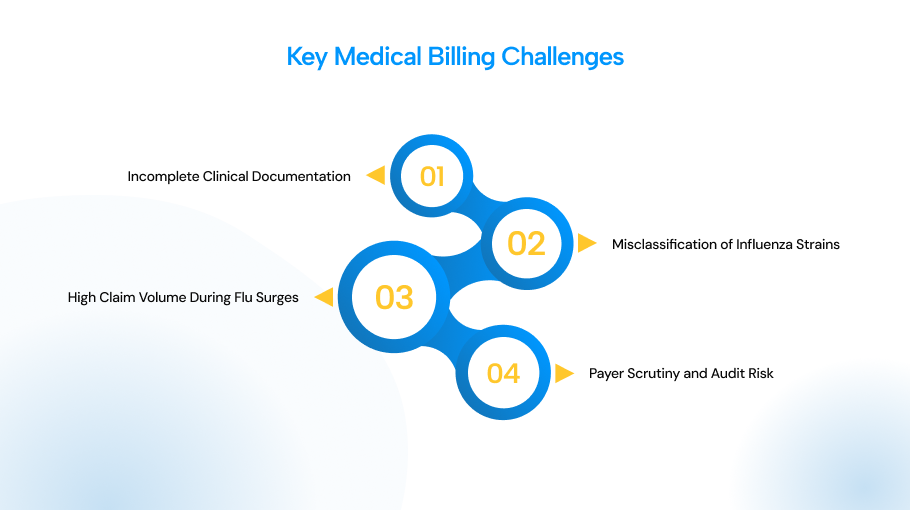
Billing claims that involve ICD-10 Code J09.X2 can create operational challenges for healthcare organizations. Influenza outbreaks usually increase patient volume, which overwhelms the billing staff, increasing claim submission timelines, the risk of coding errors, and extending the revenue cycle.
Incomplete Clinical Documentation
Incomplete documentation remains one of the most common billing barriers associated with J09.X2. Coders cannot confidently assign the correct diagnosis code when necessary details are missing.
Payers frequently reject claims that lack a clear clinical justification. Strong documentation practices ensure that the diagnosis, laboratory confirmation, and respiratory manifestation are properly connected in the patient record.
Misclassification of Influenza Strains
Confusion between seasonal influenza and novel influenza strains can lead to incorrect coding. If coders apply J09.X2 without proper confirmation, insurers may flag the claim during review, triggering payment delays or post-payment audits. Clear documentation of strain identification helps billing teams select the correct ICD-10 code and maintain compliance with payer guidelines.
High Claim Volume During Flu Surges
Flu outbreaks usually increase patient visits within a short period, which increases the likelihood of data entry errors, incomplete records, or missed documentation details.
Billing teams may rush submissions to keep up with demand, which can reduce claim accuracy. Healthcare organizations that implement structured workflows and review checkpoints are better equipped to maintain billing quality during high-volume influenza seasons.
Payer Scrutiny and Audit Risk
Claims involving novel influenza infections sometimes receive closer scrutiny from insurers, which includes reviewing medical records to confirm that laboratory evidence and respiratory manifestations justify the use of J09.X2.
If documentation lacks sufficient detail, insurers may request additional information or deny the claim. In some situations, repeated coding errors can trigger audits.
Consistent internal claim reviews and accurate clinical documentation help organizations respond confidently to payer inquiries and maintain billing compliance.
RCM Guidelines for ICD-10 Code J09.X2
Effective revenue cycle management plays a key role in maintaining accurate reimbursement for influenza-related claims.
Pre-Submission Claim Review
Before submitting claims that include J09.X2, billing teams should perform a thorough pre-submission review to ensure the accuracy of clinical documentation.
Automated claim scrubbing tools can also detect mismatched diagnosis codes or missing information. Identifying these issues early helps prevent rejections and improves the chances of timely reimbursement.
Front-End Eligibility Verification
Front-end verification of insurance coverage helps reduce billing complications before care is delivered. Staff should confirm the patient’s insurance eligibility, coverage limitations, and policy details at the time of scheduling or registration to correctly process claims, minimize delays, and reduce administrative work caused by eligibility-related denials.
Denial Trend Monitoring
Medical practices should regularly monitor denial patterns associated with influenza-related claims to identify recurring issues, such as incomplete documentation or incorrect coding.
A weekly review of claim outcomes can help organizations correct problems quickly and educate staff on common errors. Early detection of denial trends improves revenue cycle performance and supports more accurate claim submissions.
Interdepartmental Communication
Strong communication between clinical staff, coders, and billing teams improves overall claim accuracy. Providers must document clear details about the influenza diagnosis, laboratory confirmation, and respiratory involvement so coders can assign the correct code.
When questions arise, billing teams should communicate directly with clinicians to clarify documentation. This collaborative approach helps prevent claim errors and ensures that records support payer requirements.
Best Practices to Reduce Denials
Reducing denials for claims involving ICD-10 Code J09.X2 requires consistent documentation practices, clear coding standards, and proactive claim review processes. The following practices help billing teams prevent errors, respond to payer requirements, and maintain steady reimbursement during influenza seasons.
Pre-Season Documentation Training
Training clinicians before flu season helps ensure that documentation meets coding and payer requirements, reinforces correct documentation habits, reduces coding confusion, and supports accurate claim submissions during high patient volume periods.
Influenza-Specific Coding References
Internal coding reference guides containing documentation requirements, strain identification rules, and respiratory manifestation examples can help coders quickly confirm the correct use of J09.X2. These resources reduce decision time for coders and promote consistent code selection across the organization, which ultimately lowers denial rates.
Routine Claim Audits
Periodic claim audits help identify coding or documentation issues before they become widespread problems. They also provide valuable feedback to providers and coders, helping improve documentation quality and ensuring claims align with payer expectations.
Organized Laboratory Records
Maintaining organized laboratory documentation is essential when billing for J09.X2. Insurers may request proof of the confirmed influenza strain during claim review. Storing lab results in an accessible electronic system allows billing teams to quickly provide supporting evidence, which boosts claim validation and reduces the likelihood of reimbursement disputes.
Accurate Front-End Processes
Registration staff should verify patient insurance information and confirm eligibility before services are provided to ensure claims are processed without delays. Strong intake procedures reduce administrative errors and improve overall revenue cycle efficiency.
Final Word
Accurate diagnosis coding supports patient care documentation and financial stability for healthcare organizations. The Influenza A ICD-10 Code J09.X2 represents influenza cases linked with confirmed viral identification and other respiratory manifestations. Proper documentation ensures that coders apply this code correctly.
Healthcare providers should focus on detailed clinical notes, verified diagnostic results, and consistent communication with coding teams. These steps enhance claim accuracy and improve revenue cycle performance. As influenza cases continue to appear each season, correct coding will remain essential for both reimbursement and public health reporting.
Frequently Asked Questions (FAQs)
1- What does Influenza A ICD-10 Code J09.X2 represent?
It represents influenza due to a confirmed novel influenza A virus with additional respiratory manifestations.
2- Can J09.X2 be used for seasonal flu?
No. Seasonal influenza requires different ICD-10 codes. J09.X2 applies specifically to novel influenza A strains.
3- Is lab confirmation required to use J09.X2?
Lab confirmation strengthens documentation and supports claim approval, though payer policies may vary.
4- Why are claims for J09.X2 denied?
Denials often result from insufficient documentation or incorrect strain classification.
5- How can providers reduce denials related to J09.X2?
Providers should ensure detailed provider notes, confirm viral strain, verify patient insurance eligibility, and align diagnosis with documented clinical findings.